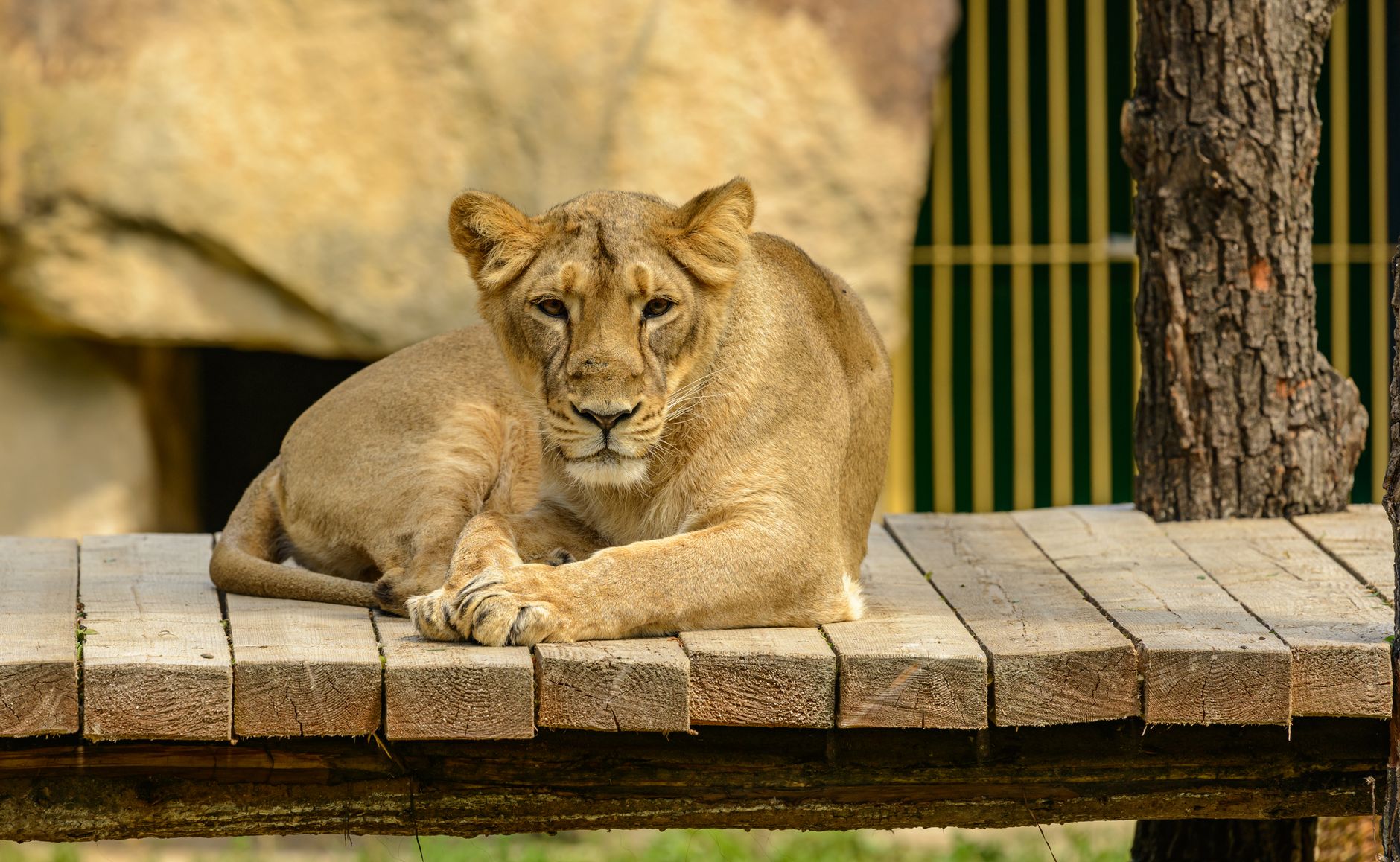
She hadn’t touched her food in four days.
Nala, a 17-year-old lioness at a wildlife conservation zoo in central Europe, had always been one of the most spirited animals in the facility. Keepers described her as “bossy” and “impossible to ignore.” But something had changed. She was retreating to the same corner of her enclosure every morning, pressing her body against the concrete wall, her amber eyes fixed on something no one else could see.
At first, the team assumed it was age. Seventeen is old for a lioness in captivity — the equivalent of a woman in her late eighties. Senior animals slow down. They sleep more. They eat less. The vets ran bloodwork. Nothing alarming came back.
But head keeper Marta Voss wasn’t convinced.
“It wasn’t how she was lying,” Marta told colleagues later. “It was where. Every single morning, same spot. Same corner. She wasn’t resting. She was watching.”
Marta began spending her breaks in the observation area, quietly studying Nala’s behavior. And on the third day, she finally saw it.
Beyond the fence line, tucked into a narrow strip of grass between the lion enclosure and the old maintenance path, a small fox had been building a den. Not unusual on zoo grounds — urban foxes often moved in quietly, unbothered by the sounds and smells that would terrify wild prey. But this fox had given birth. And one of her kits, impossibly small and still blind, had somehow crawled through a gap in the outer perimeter grass and was now lying motionless against the base of Nala’s enclosure wall.
On the other side of the barrier, the old lioness had pressed herself flat to the ground — the exact posture she’d held for days — and was breathing slowly, steadily, directly toward the tiny creature.
The team was stunned.
“I’ve worked with big cats for nineteen years,” said Dr. Erik Haugen, the facility’s senior veterinarian. “What I saw that afternoon is something I genuinely struggle to explain scientifically. She wasn’t reacting to prey. She was keeping watch.”
Zookeepers carefully retrieved the fox kit and reunited it with its mother, who had been frantically searching the perimeter. The kit was cold but alive. Within hours, it was nursing again.
That evening, for the first time in nearly a week, Nala walked to her feeding station and ate.
The staff were left to sit with something that doesn’t fit neatly into any behavioral manual. Whether Nala sensed vulnerability in the kit, felt some ancient, cross-species pull toward a creature too small and helpless to be a threat, or whether something else entirely was at work — no one could say for certain.
What they do know is that an old lioness, in the final years of her life, chose a corner and didn’t leave it. Not until the small thing on the other side of the wall was safe.
Some of the keepers cried. Most of them didn’t talk about it much afterward.
But Marta framed one photo from the security footage and hung it in the break room, where it remains to this day.