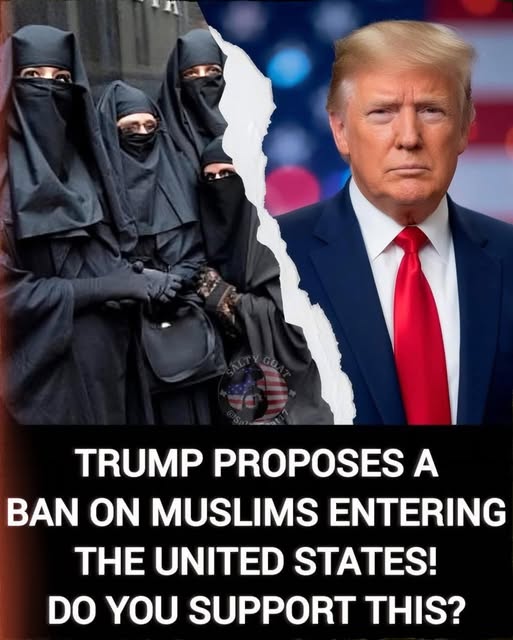
A familiar image has been making the rounds again lately — women in niqabs torn apart from a photo of Donald Trump, captioned with his old line about a “total and complete shutdown of Muslims entering the United States,” asking readers point-blank whether they support it. That quote is real. It’s also a decade old, lifted straight from a December 2015 campaign statement Trump released the day after the San Bernardino attack. The image doesn’t mention a date, doesn’t mention that the statement is from 2015, and doesn’t mention what actually became of that proposal in the years since — which is exactly the kind of missing context that makes a recycled quote feel like breaking news to anyone scrolling past it. Treating it as a fresh 2026 announcement skips over what’s actually happened since then, and what’s happening right now is, in some ways, a bigger story than the original soundbite ever was.
Here’s the short version of how we got from that 2015 statement to where things stand today. The 2015 line never became official policy as written. What did become policy, a year into Trump’s first term, was a narrower executive action: a travel ban built around specific countries rather than a religious test on paper, eventually covering eight nations after multiple court fights — six of them majority-Muslim, plus North Korea and a small set of Venezuelan officials added late in the process, widely seen at the time as an attempt to make the policy look less explicitly religious in nature. The Supreme Court upheld that version in 2018 in Trump v. Hawaii, ruling that the president has broad authority under immigration law to suspend entry from specific countries. President Biden ended the policy on his first day in office in January 2021, calling it a stain on the country’s reputation.
That might have been the end of the story, except Trump returned to office in January 2025, and one of his first executive orders directed federal agencies to spend sixty days identifying countries whose vetting and information-sharing systems were, in the order’s own language, deficient enough to justify a partial or full suspension of entry. That review produced results fast. By June 2025, a new proclamation was in place, this time covering nineteen countries — more than double the number in the original ban that reached the Supreme Court. It went further than the first version in another way too: rather than focusing mainly on tourist and business visas, the new ban reaches nearly every visa category, including students, scholars, and even many applicants for permanent residency, among them relatives of U.S. citizens who had already been waiting years in the immigration system. Government data cited by immigration researchers shows nearly 34,000 immigrant visas were issued in just those affected categories in fiscal year 2023 alone, which gives some sense of how many people are now stuck mid-process.
It’s worth understanding the legal tool being used here, because it didn’t start with Trump. Section 212(f) of the Immigration and Nationality Act gives the president broad authority to suspend entry of any class of foreign nationals found to be detrimental to U.S. interests, and it’s been invoked by presidents from both parties over the decades — Reagan used it against Cuban nationals in the 1980s, Carter used a version of it during the Iran hostage crisis, and Obama used it for narrower sanctions-related restrictions tied to specific conflicts. What’s different about the 2017 and 2025 versions isn’t the legal authority itself, which courts have consistently read broadly, but the scale and the list of countries involved, which is exactly what both supporters and critics end up arguing about.
And the list didn’t stop growing. By the start of 2026, advocacy groups tracking the policy reported that seven countries plus Palestinian travel document holders were facing a full bar on entry for anyone without an existing valid visa — Burkina Faso, Laos, Mali, Niger, Sierra Leone, South Sudan, and Syria, alongside Palestine. Another fifteen countries were facing partial restrictions: Angola, Antigua and Barbuda, Benin, Côte d’Ivoire, Dominica, Gabon, Gambia, Malawi, Mauritania, Nigeria, Senegal, Tanzania, Tonga, Zambia, and Zimbabwe. Add it together with the original June list, and groups like the New York Immigration Coalition put the combined population of all affected countries at over a billion people — something like one in eight people on the planet now living somewhere on the restricted list. Reporting from the Brennan Center for Justice in mid-2025 suggested the administration was already weighing whether to add roughly three dozen more countries on top of that.
The administration’s case for all of this is built entirely around security and process, not religion. The argument goes that certain countries simply can’t or won’t share the kind of identity, criminal, and counterterrorism information the U.S. needs to vet travelers properly, that some have unacceptably high visa overstay rates, and that until those systems improve, suspending entry is a reasonable precaution rather than a targeted policy against any one faith. Nothing in the 2025 executive order or the proclamations that followed names a religion. On paper, it’s a list of countries, evaluated against a set of vetting criteria, the same legal mechanism — section 212(f) of the Immigration and Nationality Act — that’s been used by presidents of both parties for decades to restrict travel in narrower circumstances.
Critics don’t buy that the country-by-country framing tells the whole story. The Brennan Center’s analysis of the June 2025 proclamation argued the security justifications looked cherry-picked to match a list of countries — heavily Muslim-majority and African — that Trump had publicly criticized or vowed to restrict long before any formal vetting review took place, and noted the new ban’s reach into family-based green card categories goes well beyond anything resembling a narrow security measure. Citing Justice Sonia Sotomayor’s dissent when the Supreme Court upheld the original ban in 2018, opponents argue the government is once again trying, in her words, to launder the policy of its discriminatory taint, just with a longer list and a more detailed paper trail of stated justifications this time. Whether that argument would hold up against the 2018 precedent in court is genuinely unsettled — the Supreme Court’s ruling gave the executive branch wide latitude on exactly this kind of proclamation, which means legal challenges to the 2025 and 2026 versions face a steep climb no matter how broad the list gets.
That’s part of why the more active pushback right now is happening in Congress rather than the courts. A group of Democratic lawmakers — Representative Judy Chu, Senator Chris Coons, and House colleagues including Jerry Nadler, Don Beyer, Ilhan Omar, André Carson, and Rashida Tlaib — reintroduced the National Origin-Based Antidiscrimination for Nonimmigrants Act, known as the NO BAN Act, which would bar future presidents from suspending entry based on religion or national origin and require any such suspension to be narrowly tailored, evidence-based, and run through Congress rather than executive proclamation alone. It’s not the bill’s first time being introduced — earlier versions stalled without becoming law — and given Republican control of at least one chamber, its odds this time aren’t obviously better.
For the people actually affected, the legal and political arguments matter less than the practical reality. Families with approved visa petitions are now facing indefinite delays reuniting with relatives. Students and skilled workers who’d already cleared earlier stages of the immigration process are stuck waiting on a list that keeps expanding. Refugees with formal resettlement assurances, the same category that triggered emergency court battles back in 2017, are again caught in the gap between an approved case and an actual flight. Immigration attorneys have described a familiar pattern from the first ban repeating itself: people with plane tickets already booked finding out at the gate, or before it, that the rules changed underneath them.
Public opinion on this kind of policy has never broken down cleanly, and there’s little reason to think it will this time either. When the original ban was litigated back in 2017 and 2018, polling consistently showed a sharp partisan split — solid majorities of Republicans supporting the idea of tighter vetting from countries with terrorism concerns, and solid majorities of Democrats viewing it as discriminatory regardless of how it was worded, with independents landing somewhere in between depending on exactly how a given poll phrased the question. Pollsters have noted that small changes in wording — whether a survey says “Muslim ban,” “travel ban,” or “enhanced vetting from high-risk countries” — can shift the results substantially, which is itself a clue about how much the framing of a policy like this shapes how people feel about it before they ever look at the details.
Legal challenges to the 2025 and 2026 expansions are already working their way through federal courts, brought by some of the same organizations that fought the original ban, including the ACLU. But attorneys on both sides of those cases are working in the shadow of the 2018 Supreme Court ruling, which means plaintiffs need to find a meaningfully different legal argument than the one the Court already rejected once, rather than simply re-running the same case against a longer list of countries.
So is it accurate to call this a “Muslim ban,” the way the viral image frames it? That depends entirely on whether you’re judging the policy by its written text or by its practical effect. By the letter of the executive orders, no religion is named anywhere, and the administration has been careful to keep it that way, learning from how the first version got dragged through years of litigation partly because Trump’s own 2015 and 2016 statements about Muslims were used as evidence of discriminatory intent. By its real-world impact, a policy that disproportionately restricts entry from Muslim-majority nations, expands faster than its predecessor, and traces its origin to an executive order written by the same person who once explicitly called for excluding Muslims, looks to its critics like the same underlying goal pursued through more careful legal packaging.
What’s clear is that the actual 2026 situation is both bigger and more complicated than a recycled 2015 quote can capture. It’s not a single yes-or-no proposal anymore. It’s a live, expanding list of countries, a stalled congressional bill trying to rein it in, a set of active federal lawsuits, and a Supreme Court precedent that makes the policy very difficult to challenge regardless of how far it grows from here. Whichever side of this you land on, the honest version of the question isn’t “do you support banning Muslims” — that was never the policy as written, then or now. It’s whether you think a country-by-country vetting system that happens to fall hardest on Muslim-majority and African nations is a legitimate security tool or a workaround for something the courts already wouldn’t allow done directly. People who’ve looked closely at the same set of facts have landed on both sides of that question, often for reasons that have more to do with how much they trust the stated rationale than with any disagreement about the underlying numbers.
The full list of currently restricted countries, along with links to the executive order and the proclamation text, is in the comments below.