For eighteen years, he worked double shifts, skipped meals, and never once complained. He only ever had one question: was it enough? On a quiet Tuesday morning, he finally got his answer — and it came from the last place he ever expected.
This is the story of a seventeen-year-old boy who became a father overnight, chose to stay when it would have been easier to leave, and raised a daughter who would one day show the world exactly what kind of man he was.
There is a particular kind of courage that never makes the news. It does not announce itself. It does not wear a uniform or carry a title or cross a finish line with cameras watching. It shows up at six in the morning in a small apartment kitchen, packing a school lunch before a double shift. It shows up at a parent-teacher conference after three hours of sleep. It shows up in the small, daily, unremarkable choices that nobody sees and nobody applauds, made by someone who simply decided that love was a verb and not a feeling — and that the child sleeping in the next room deserved everything he had to give, even on the days when he was not sure he had anything left. This is the story of that kind of courage. This is the story of a father named Marcus. And of a daughter named Ainsley. And of the morning a knock at the door changed everything he thought he knew about the life he had built.
Seventeen and Suddenly a Father
Marcus was seventeen years old when the test came back positive. He was a junior in high school, working part-time at a hardware store on weekends, with plans that were still loose and unformed in the way that seventeen-year-old plans tend to be. His girlfriend, Priya, was the same age — bright, ambitious, already talking about the university programs she wanted to apply to. When she told him, they were sitting in his car in a parking lot, and the world, as Marcus later described it, got very quiet and very large at the same time.
They talked about it for weeks. They made plans — the kind that two teenagers make when they are trying to be mature beyond their years, carefully constructing a future on the shifting foundation of circumstances neither of them had chosen. They would raise the baby together. They would figure it out. People had done harder things. Marcus believed that with a sincerity that only the very young can fully sustain in the face of evidence to the contrary.
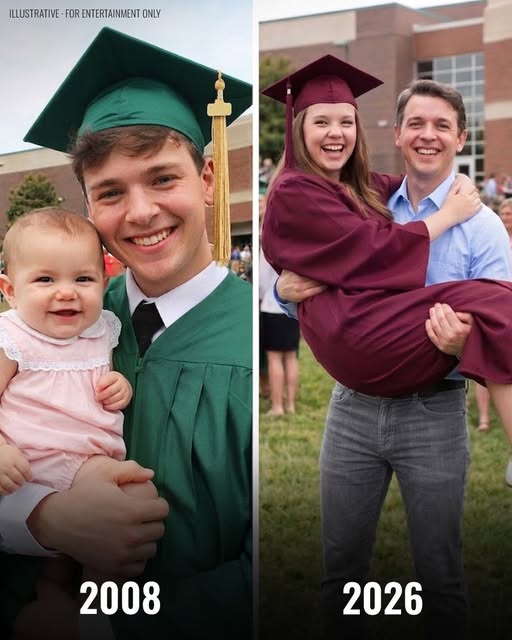
Ainsley arrived in March, seven weeks before Marcus finished his senior year. He sat his final exams with the smell of newborn still on his shirt and a photograph tucked inside the cover of his math textbook. He passed everything. He walked at graduation with a cap and gown and a sleeping infant waiting at home with his mother, who had stepped in without being asked because that was the kind of woman she was. It was, by any measure, an extraordinary beginning to an ordinary life.
Three months after graduation, Priya left. She had deferred her university acceptance once. She did not defer it a second time. The conversation was brief and devastating in the way that conversations are when both people already know what is going to be said before a word is spoken. She wanted a different life. She was sorry. She hoped Marcus understood. He did not, fully — not for a long time. But he nodded, and he held Ainsley a little tighter that evening, and the next morning he called his manager at the hardware store and asked about picking up additional shifts.
“He never spoke badly about her mother to Ainsley. Not once. Not in eighteen years. When Ainsley asked, he said only that some people need different things from life, and that was okay, and that she was loved completely by the people who were there.”
The Years That Built Them Both
The years that followed were not easy, and Marcus has never pretended they were. He has told the story enough times, in the careful and honest way of someone who believes that sanitizing hardship does nobody any favors, that a clear picture emerges of what those years actually looked like from the inside. The hardware store became a construction job became a foreman’s position earned through a decade of showing up early and leaving late and learning everything there was to learn about a trade that rewarded exactly those qualities. The small apartment became a slightly larger one when Ainsley was five, and then a rented house with a yard when she was nine, because she had asked once if she could ever have a place to play outside and Marcus had worked six-day weeks for fourteen months to make it happen.
There were the school mornings — the braiding of hair that he taught himself from YouTube tutorials at eleven o’clock at night, watching the same videos over and over until his hands knew what to do. There were the science fair projects assembled at the kitchen table at midnight. There were the dance recitals where he sat in the front row with a video camera borrowed from a neighbor, the only father in a sea of mothers, entirely unbothered by the fact. There were the illnesses — the ear infections and the flu and the one terrifying week when Ainsley was four and running a fever that would not come down and Marcus sat beside her bed for three nights straight, watching her breathe, bargaining with whatever forces govern these things for the chance to watch her grow up.
She grew up. She grew up smart and curious and funny in the dry, understated way that children sometimes develop when they spend a lot of time around adults who take them seriously. She grew up with strong opinions about things that mattered and a generosity toward people that her teachers commented on every single year without fail. She grew up knowing, with the bone-deep certainty that only comes from consistent and demonstrated love, that there was one person in the world who would always, without condition or hesitation, show up for her. She grew up knowing her father.
Graduation Night
The night of Ainsley’s high school graduation was one of the happiest of Marcus’s life. He sat in the bleachers of the school gymnasium in his best shirt, the one he saved for occasions that deserved it, and watched his daughter cross the stage to collect her diploma. She found his face in the crowd before she reached the principal’s hand — he had always been easy to spot, always in the front rows, always the one standing before it was quite appropriate to stand — and she smiled at him with a smile that contained eighteen years of everything they had been to each other. He cried, openly and without embarrassment, the way fathers cry at these moments when they let themselves feel the full weight of what has been accomplished.
After the ceremony she went out celebrating with friends — of course she did, she was eighteen and it was graduation night and she had earned every moment of it. Marcus drove home, made himself a cup of tea, and sat in the quiet of the house they had shared for nine years, feeling the particular bittersweet fullness of a chapter ending and not yet knowing what came next. He was in bed by eleven. He slept better than he had in weeks.
He was making coffee the next morning when the knock came at the door.
The Officers at the Door
Two police officers. Standing on his front step at eight forty-five in the morning, the day after his daughter’s graduation. The coffee mug in Marcus’s hand went very still. The mind does what minds do in those moments — it races through every possible meaning of the image in front of it, discarding the benign interpretations first, arriving at the worst ones with a speed that leaves the stomach somewhere on the floor. Ainsley had come home late. He had heard the door. But late — and the officers were here — and —
“Sir,” one of them said, and the word landed like a stone, “do you have any idea what your daughter has been hiding from you?”
Marcus said afterward that his legs went strange beneath him. He held the door frame. He nodded, or tried to, because he could not immediately locate his voice. The officer — a woman, he noticed, with a calm and deliberate manner that he would later be grateful for — held out a manila folder. She said nothing else. She simply handed it to him and waited.
What Was Inside the Folder
The photographs were printed on plain paper, the way official documents are, but their subjects were anything but official. There was Ainsley at a food drive — seventeen, maybe sixteen, stacking boxes with the focused efficiency of someone who had done this many times before. There was Ainsley at a hospital visiting ward, sitting beside an elderly woman in a bed, holding her hand, reading to her from a paperback book. There was Ainsley organizing a community cleanup, a hi-visibility vest over her school uniform, directing volunteers twice her age with a clipboard and a confidence that made Marcus’s throat tighten when he looked at it. There were pictures from homeless shelters and after-school tutoring programs and neighborhood gardens planted on vacant lots. There were pictures he had never seen, capturing a version of his daughter’s life that she had built entirely in the spaces he had not been watching.
The officer explained it quietly and carefully. For three years — beginning when Ainsley was fifteen — she had been quietly building a volunteer network across their county. She had recruited friends, organized schedules, applied for small grants through the school, and coordinated hundreds of hours of community service that had touched the lives of an estimated four hundred and thirty people in their area. The previous evening, at a community ceremony held the same night as her graduation — which was why she had come home late — Ainsley had been awarded the county’s highest community service honor for young people. She had accepted it. And she had asked everyone in the room, every official and teacher and community leader present, to say nothing to her father. She wanted to tell him herself. She wanted it to be a surprise.
There was a letter at the back of the folder. Handwritten, in Ainsley’s careful cursive, on two sheets of lined notebook paper.
📄 Ainsley’s Letter — In Her Own Words
“Dad. I have been trying to figure out how to say this for a long time, and I still don’t think I have the right words, but here is what I know. You became a father when you were seventeen years old and you were scared and nobody would have blamed you for walking away. You didn’t walk away. You stayed. You showed up every single day for eighteen years without ever once making me feel like a burden or a mistake or anything other than the most important thing in your life. I have watched you work yourself to exhaustion and still come home and ask about my day. I have watched you go without things so that I could have them and never mention it. I have watched you be the kind of person I wanted to be when I grew up. Everything I have done — every food drive, every hospital visit, every hour of volunteering — I did because you showed me what it looks like to give without expecting anything back. You taught me that by living it. Every good thing I am came from you. I love you more than I will ever be able to say. — Ainsley.”
The Hug That Said Everything
Marcus stood at his front door with the folder in his hands and tears running down his face without any attempt to stop them. The officers, both of them, stood quietly and gave him the time. There is no protocol for this particular kind of moment — the moment when eighteen years of quiet, unwitnessed devotion is suddenly, completely, and irrevocably seen. No manual covers it. You simply stand and feel it move through you like weather.
He heard footsteps on the stairs behind him. Ainsley had heard the knock. She appeared in the hallway in her pajamas, hair still sleep-tangled, and she saw the folder in his hands and the tears on his face and she crossed the distance between them in four steps and he held her — held her the way he had held her the first time, in the hospital, seventeen years old and terrified and certain of absolutely nothing except that he would spend the rest of his life making sure she was okay.
“Was it enough?” he had asked himself ten thousand times across eighteen years, in the small dark hours when doubt comes for every parent who has ever tried their best and wondered if their best was sufficient. Standing in his doorway on a Tuesday morning with his daughter in his arms and two police officers smiling quietly on his front step and a letter in his hand that answered the question once and for all — he finally knew.
It was enough. It had always been enough. It had been, in every way that mattered, everything.
“He didn’t raise a daughter who needed the world to notice her. He raised a daughter who went out and quietly made the world better — and that was the most complete answer any father could ever receive to the question he had been carrying for eighteen years.”
What Comes Next
Ainsley begins university in the fall on a full scholarship — a fact that Marcus learned about the same morning, tucked at the back of the folder, noted by the officer as an additional detail she had thought he might want to know. She will study social work. This surprises nobody who knows her. She intends to expand the volunteer network she built in high school into something larger, more structured, capable of reaching communities beyond their county. She has already been in contact with a nonprofit organization interested in helping her do exactly that. She is eighteen years old.
Marcus went back to work on Wednesday. He is a foreman now, with a crew that respects him and a reputation built on twenty years of showing up and doing the job. His colleagues noticed something different about him that week — a particular quietness, a settled quality, like a man who has put something down that he had been carrying for a very long time. When they asked, he told them the story. Several of them cried. One of them, a man in his fifties who had his own complicated history with fatherhood, shook Marcus’s hand and held it for a long moment and did not say anything, because there was nothing that needed to be said.
The folder sits on the kitchen table. Marcus has not moved it. He is not sure he ever will. Some things deserve to stay exactly where they landed — in the light, visible, a reminder of the morning the world confirmed what love already knew. He raised Ainsley alone. He raised her well. And she grew up to be the kind of person who, without being asked, made it her mission to carry that same quiet, tireless, unannounced generosity out into a world that needed it desperately and received it gratefully.
He was seventeen when it started. He had been terrified and uncertain and completely, stubbornly unwilling to leave. And all these years later, standing in the morning light with his daughter’s arms around him and her letter in his hand, he understood something that no amount of doubt had ever quite been able to take from him — that staying, simply staying, is sometimes the most extraordinary thing a person can do. And that the children who are stayed for have a way, eventually, of showing you exactly what it was worth.