The stakes could hardly be higher.
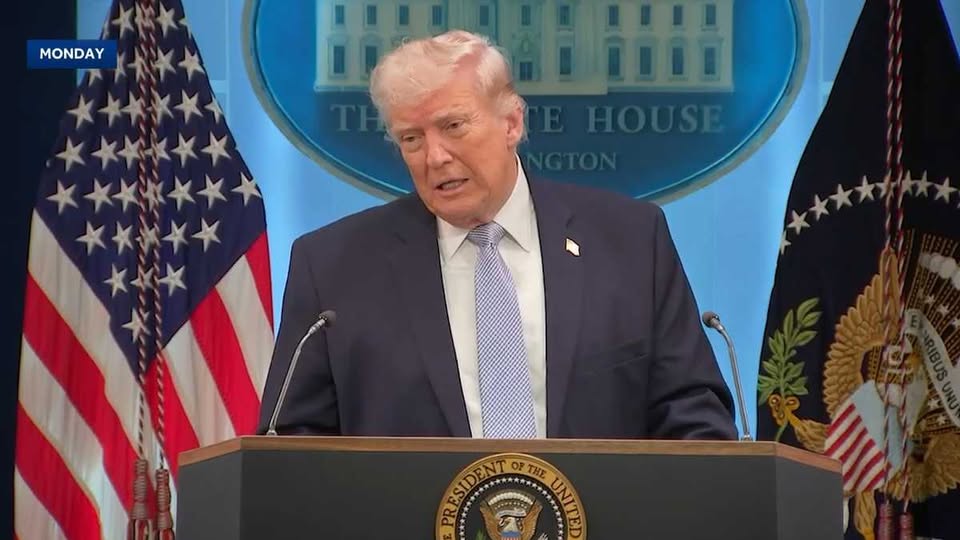
From the podium in Washington, President Donald Trump delivered one of the starkest ultimatums of his presidency: reopen the Strait of Hormuz by Tuesday evening, or face what he described as “complete demolition” of critical infrastructure across Iran. Bridges, power plants, and key systems—he warned—could be reduced to rubble within hours. The language was not diplomatic. It was direct, forceful, and designed to leave little room for ambiguity.
At the center of this confrontation is one of the most strategically vital waterways in the world: the Strait of Hormuz. Narrow, heavily trafficked, and geopolitically sensitive, it serves as a gateway for a significant portion of the world’s oil supply. Any disruption to its flow reverberates far beyond the Middle East, affecting global markets, energy prices, and economic stability across continents.
Trump’s deadline—8 p.m. Eastern on Tuesday—comes after multiple extensions. Previous dates in late March and early April came and went without resolution, each accompanied by escalating rhetoric. Now, the president insists this is the “final offer,” framing the moment as a decisive turning point rather than another phase in prolonged negotiations.
His warning was as sweeping as it was specific.
“We have a plan… where every bridge in Iran will be decimated… every power plant… burning, exploding, and never to be used again,” Trump said, emphasizing the scale and speed of potential action. He added that such an operation could be carried out in as little as four hours—an assertion meant to underscore both capability and readiness.
Yet even within the threat, there was a dual message.
“We don’t want that to happen,” he said.
That tension—between overwhelming force and stated reluctance—defines the current moment. It reflects a strategy that blends coercion with the possibility of negotiation, pressure with the suggestion of an off-ramp. But whether that balance holds depends largely on how the other side responds.
In Tehran, the response has been firm.
Iran rejected a 45-day ceasefire proposal earlier this week, calling instead for a permanent end to hostilities and guarantees against future attacks. From their perspective, temporary pauses are insufficient. They are seeking structural assurances—commitments that would fundamentally alter the terms of engagement, not just delay the next confrontation.
This divergence in expectations creates a widening gap.
For Washington, the immediate priority is reopening the strait—a concrete, measurable action that would restore stability to global shipping routes. For Tehran, the focus is longer-term security, rooted in distrust of temporary agreements and skepticism about enforcement.
Between those positions lies a narrow and shrinking space for compromise.
Trump, however, has suggested that negotiations are not entirely off the table. “We have an active, willing participant on the other side,” he said, hinting at ongoing backchannel discussions. But the ambiguity of that statement leaves open critical questions. Who is participating? At what level? And under what conditions?
In high-stakes diplomacy, signals matter as much as substance.
Public ultimatums can strengthen a negotiating position by demonstrating resolve, but they can also harden opposition by limiting flexibility. When deadlines are framed as final, backing down becomes politically costly. When threats are maximal, the room for incremental compromise narrows.
This is the paradox of escalation.
Each side seeks leverage, but in doing so, they may reduce the very options that could lead to de-escalation. The more definitive the language, the more difficult it becomes to pivot without appearing to concede.
The potential consequences of failure are profound.
A large-scale strike on Iran’s infrastructure would not be a contained event. It would likely trigger retaliation, whether through direct military response, proxy actions, or further disruption of maritime routes. The Strait of Hormuz itself could become a flashpoint, with shipping lanes turning into zones of conflict rather than commerce.
Global markets are already reacting to the uncertainty.
Energy prices fluctuate with each new statement, each extension, each hint of movement or stalemate. Insurance rates for shipping through the region have risen. Governments are monitoring the situation closely, aware that a disruption in the strait could have cascading effects on supply chains and economic stability.
Beyond economics, there is the human dimension.
Infrastructure is not abstract. Bridges connect communities. Power plants sustain hospitals, homes, and essential services. The destruction described in Trump’s warning would have immediate and long-term impacts on civilian life. Even when targeting is precise, the ripple effects extend far beyond intended objectives.
This raises enduring questions about proportionality and strategy.
What is the objective of such a strike? Is it to compel compliance, degrade capability, or send a broader signal? And how does one measure success in a context where immediate outcomes may differ from long-term consequences?
Supporters of the president’s approach argue that clarity and strength are necessary.
From their perspective, ambiguity invites miscalculation. By outlining both the demand and the consequences in unmistakable terms, the administration reduces the risk of misunderstanding. The message is simple: reopen the strait, or face overwhelming force.
They see this as deterrence in its most direct form.
Critics, however, warn that such an approach can backfire.
They argue that ultimatums leave little room for face-saving compromises, particularly for governments that must maintain domestic legitimacy. When demands are public and absolute, any concession can be framed as capitulation. In that context, even leaders inclined toward negotiation may find themselves constrained by internal pressures.
The result can be a stalemate that neither side intended.
History offers examples of both outcomes. In some cases, strong ultimatums have forced rapid compliance. In others, they have precipitated conflict precisely because they removed alternative paths.
Which path this situation will follow remains uncertain.
What is clear is that time is now a central variable. Deadlines concentrate attention, but they also compress decision-making. As the clock moves toward Tuesday evening, options become more limited, and the cost of miscalculation rises.
Behind the scenes, diplomatic efforts are almost certainly intensifying.
Allies, intermediaries, and international organizations may be working to bridge the gap, to translate demands into proposals, to find language that both sides can accept. These efforts are rarely visible, but they are often decisive.
Whether they succeed may depend on the willingness of both sides to adjust their positions—if only slightly.
For Washington, that could mean framing the demand in a way that allows for phased compliance rather than immediate reversal. For Tehran, it could mean signaling openness to interim measures while continuing to pursue longer-term guarantees.
These are not easy shifts.
They require political risk, strategic calculation, and a degree of trust that may be in short supply. But without them, the trajectory points toward escalation.
And escalation, once initiated, is difficult to contain.
Military plans, once set in motion, follow their own logic. Responses generate counter-responses. What begins as a targeted operation can expand, drawing in additional actors, complicating objectives, and increasing uncertainty.
This is why moments like this matter.
They are not just about immediate decisions, but about the frameworks that guide those decisions. How leaders balance pressure and restraint, how they interpret signals from the other side, how they weigh short-term gains against long-term risks—all of these factors shape the outcome.
Trump’s warning has made one thing unmistakable: the margin for error is shrinking.
The next hours and days will determine whether this confrontation moves toward resolution or rupture. Whether the Strait of Hormuz returns to its role as a conduit of global commerce, or becomes the focal point of a broader conflict.
For now, the world is watching.
Not just for what happens, but for how it happens—for the choices made under pressure, for the signals sent and received, for the balance between القوة and caution.
Because in moments like this, decisions do not stay contained.
They ripple outward, shaping not only the present crisis, but the expectations and strategies that will define the next one.