The world didn’t just watch—it recalibrated.
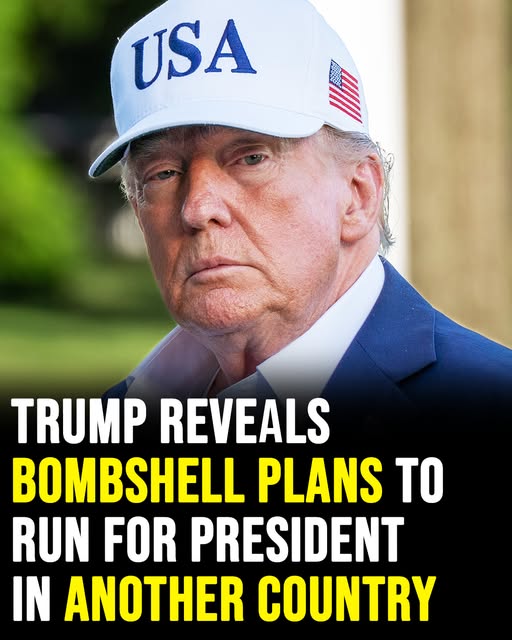
What sounded, at first, like another offhand remark from Donald Trump quickly revealed something more unsettling. During a recent press conference, Trump openly joked that after finishing his presidency, he might run for president of Venezuela, claiming he would “poll higher than anybody” and could “quickly learn Spanish” to make it happen . On its surface, the comment carried the familiar tone of bravado and spectacle. But placed in context—military intervention, regime change, and escalating geopolitical tensions—it stops sounding like a joke and starts sounding like a signal.
Because this isn’t happening in a vacuum.
Earlier in 2026, the United States carried out a dramatic military operation that resulted in the capture of Venezuelan leader Nicolás Maduro, who was subsequently transported to the U.S. to face charges . In the aftermath, Washington declared its intention to oversee a “transition,” even suggesting it would “run” Venezuela temporarily until stability could be restored . An interim government under Delcy Rodríguez was installed, though its legitimacy has been questioned both domestically and internationally.
This is the backdrop against which Trump’s comment lands.
So when he says he might simply “go to Venezuela and run for president,” it isn’t just an eccentric aside. It echoes a deeper pattern—one where power is no longer confined by geography, where influence bleeds across borders, and where the line between political theater and geopolitical intent becomes dangerously thin.
At its core, the remark exposes a transformation in how power is imagined. Traditionally, democratic leadership is rooted in citizenship, constitutional limits, and national identity. You belong to a political system; you don’t simply transfer between them. Trump’s framing flips that logic. In his telling, leadership becomes portable—almost transactional. If one system imposes limits (like the U.S. Constitution’s two-term rule), then another system becomes a workaround.
That idea is not just unconventional; it is destabilizing.
Because democracy depends on boundaries—not just physical ones, but legal and institutional ones. When those boundaries are treated as optional or interchangeable, the entire concept of self-governance begins to erode. The suggestion that a former U.S. president could simply step into another country’s leadership—especially one shaped by U.S. military intervention—raises uncomfortable questions about sovereignty. Who chooses a nation’s leader? Its people, or the forces powerful enough to reshape its political landscape?
Trump’s rhetoric thrives in that ambiguity.
His claim that Venezuelans “love him” and that he would dominate their polls has no verifiable basis, but that’s almost beside the point. The function of the claim is not accuracy—it’s narrative construction. It projects inevitability, dominance, and desirability all at once. It reframes foreign populations as receptive audiences, waiting for his leadership. In doing so, it collapses the distinction between domestic political branding and international legitimacy.
And then there’s the language itself.
The promise to “quickly learn Spanish,” followed by dismissive remarks about language learning, captures a familiar duality: performative adaptability paired with underlying contempt. It’s a pattern that has defined much of Trump’s political style—embracing global ambition while simultaneously rejecting the cultural humility that such ambition would require. Leadership, in this vision, doesn’t demand integration; it demands assertion.
That tension matters because it reveals how power is being conceptualized—not as a relationship between leader and people, but as a projection of will.
Meanwhile, the broader geopolitical context amplifies the stakes. The U.S. intervention in Venezuela has already drawn criticism for its legality and long-term consequences . Questions remain about whether the operation was driven by democratic ideals, strategic interests, or access to Venezuela’s vast oil reserves. Into that uncertainty steps a narrative where the same leader who oversaw the intervention casually entertains the idea of personally ruling the country.
Even if intended as humor, it reinforces a perception that power is not just exercised—but owned.
And ownership changes everything.
Because once power is seen as something transferable, negotiable, or even collectible, the rules that govern it begin to lose their force. Constitutional limits become obstacles rather than safeguards. National sovereignty becomes conditional rather than absolute. Democracy becomes less about collective decision-making and more about who can command the largest stage.
This is why the comment resonates beyond its immediate absurdity.
It taps into a broader shift in political culture—one where spectacle often overshadows substance, where provocative statements generate more traction than policy, and where the boundaries of acceptable discourse are constantly being tested. Trump has long operated at the edge of those boundaries, using exaggeration and provocation as tools. But the danger lies in how repeated exposure normalizes the extreme.
What begins as a joke can evolve into a framework.
History offers cautionary lessons here. Political norms rarely collapse overnight; they erode gradually, through repeated challenges that go unpunished or unaddressed. Each time a boundary is crossed without consequence, it becomes easier to cross again. Over time, what once seemed unthinkable becomes merely controversial—and eventually, perhaps, acceptable.
That is the real risk embedded in moments like this.
Not that Trump will literally run for president of Venezuela, but that the idea itself enters the realm of possibility. That it reshapes expectations about what leaders can say, what they can aspire to, and what constraints truly bind them. That it contributes to a political environment where power is increasingly detached from accountability.
And that detachment is where democracies become vulnerable.
Because democracy is not just a system of elections; it is a system of limits. It depends on the willingness of leaders to accept constraints, to respect institutions, and to recognize that authority is granted—not seized or transferred at will. When those principles are treated as optional, the system begins to weaken from within.
In that sense, Trump’s remark is less about Venezuela than it is about the future of political power itself.
It raises a question that extends far beyond one press conference: what happens when leaders stop seeing boundaries as real? When constitutions become inconveniences? When countries become stages rather than communities?
The answer isn’t immediate. It unfolds slowly, in shifts of tone, expectation, and behavior. But the trajectory is clear.
When power meets ego without limits, borders don’t just look negotiable.
They start to disappear.