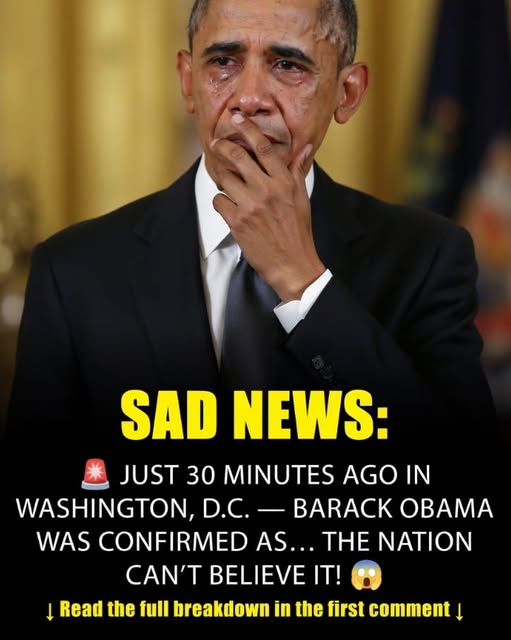
In a highly charged and controversial statement delivered from the Oval Office on July 22, former President Donald Trump reignited long-standing political tensions by accusing former President Barack Obama of committing “treason” in relation to the 2016 U.S. presidential election. Speaking to reporters, Trump asserted, “It’s there, he’s guilty. This was treason,” alleging that the Obama administration attempted to undermine the integrity of the election by manipulating intelligence assessments surrounding Russian interference. The remarks, which were not accompanied by any new or verifiable evidence, have drawn immediate backlash from political figures, intelligence experts, and former officials.
Trump’s claims center on a narrative he has promoted for years—that elements within the U.S. intelligence community and the Obama administration exaggerated or fabricated Russian interference in order to delegitimize his electoral victory. According to Trump, the administration “tried to obfuscate the election” in unprecedented ways. This language suggests not just political disagreement, but an accusation of deliberate subversion of democratic processes—one of the most serious charges that can be made against a former president.
Adding fuel to the controversy were comments from Director of National Intelligence Tulsi Gabbard, who echoed Trump’s assertions by describing the situation as a “treasonous conspiracy.” Gabbard’s remarks, coming from a high-ranking intelligence official, have intensified scrutiny and raised questions about the politicization of intelligence institutions. Critics argue that such statements risk undermining public trust in agencies that are expected to operate independently of political influence.
However, these claims stand in stark contrast to the findings of multiple investigations conducted over the past decade. The U.S. intelligence community, including agencies such as the CIA, NSA, and FBI, concluded with high confidence that Russia did attempt to interfere in the 2016 election through cyber operations, disinformation campaigns, and other means. These conclusions were later supported by the bipartisan Senate Intelligence Committee report, which found no evidence that the intelligence assessments were politically motivated or manipulated by the Obama administration.
Importantly, while these investigations confirmed attempts at interference, they also consistently stated that there was no evidence the interference altered the final vote count or changed the outcome of the election. This distinction has been central to the official position of the U.S. government: that while foreign interference occurred, the integrity of the voting process itself remained intact. Russia, for its part, has repeatedly denied any involvement, dismissing the allegations as baseless and politically motivated.
The response to Trump’s latest statements has been swift and pointed. A spokesperson for Obama, Rodenbush, broke from the former president’s typical practice of avoiding direct engagement with Trump’s rhetoric. “Out of respect for the presidency, our office usually ignores the nonstop misinformation from this White House,” Rodenbush said. “But these claims are outrageous enough to merit a response.” The statement reflects a growing concern among former officials that such accusations, if left unchallenged, could erode public understanding of established facts.
Legal experts have also weighed in, emphasizing the gravity of the term “treason.” Under the U.S. Constitution, treason is narrowly defined as levying war against the United States or adhering to its enemies by giving them aid and comfort. Accusations of treason are exceedingly rare and require a high standard of proof. Critics argue that using the term in a political context without substantiated evidence not only dilutes its meaning but also risks inflaming partisan divisions.
The broader political implications of these developments are significant. Trump’s statements come at a time of heightened polarization, where competing narratives about past elections continue to shape public discourse. By revisiting and amplifying claims about 2016, Trump appears to be reinforcing a narrative that challenges the legitimacy of longstanding institutional conclusions. This strategy may resonate with segments of the electorate who are skeptical of government institutions, but it also deepens divisions over what constitutes credible evidence and authoritative information.
At the same time, the involvement of a sitting Director of National Intelligence in promoting similar claims raises additional concerns. Intelligence agencies are traditionally expected to remain apolitical, providing objective assessments based on available data. When senior officials appear to align with partisan narratives, it can create the perception that intelligence is being used as a political tool rather than a neutral source of analysis. This perception, whether accurate or not, can have lasting consequences for public trust.
Internationally, the controversy may also have ripple effects. Allegations of election interference and internal political conflict can influence how other countries perceive the stability and credibility of U.S. democratic institutions. For allies, it may raise questions about consistency and reliability, while for adversaries, it could be seen as an opportunity to exploit divisions through information campaigns.
Despite the intensity of the rhetoric, it is important to note that no new evidence has been presented to substantiate the claims made by Trump or Gabbard. The absence of supporting documentation or corroboration from independent sources remains a central issue. In the realm of national security and electoral integrity, assertions of this magnitude typically require rigorous verification, given their potential impact on public confidence and institutional legitimacy.
Ultimately, this episode underscores the enduring complexity of the 2016 election’s legacy. Nearly a decade later, it continues to serve as a focal point for competing interpretations, political narratives, and questions about the role of foreign actors in democratic processes. While official investigations have provided detailed accounts of what occurred, the persistence of alternative claims highlights the challenges of achieving consensus in a deeply divided political environment.
As the debate continues, the need for clear, evidence-based communication becomes increasingly critical. In an era where information spreads rapidly and often without verification, the responsibility to distinguish between substantiated findings and unproven allegations falls not only on public officials but also on the broader media ecosystem. The stakes are high, as the integrity of democratic institutions depends in part on the public’s ability to trust the processes and the information that underpins them.