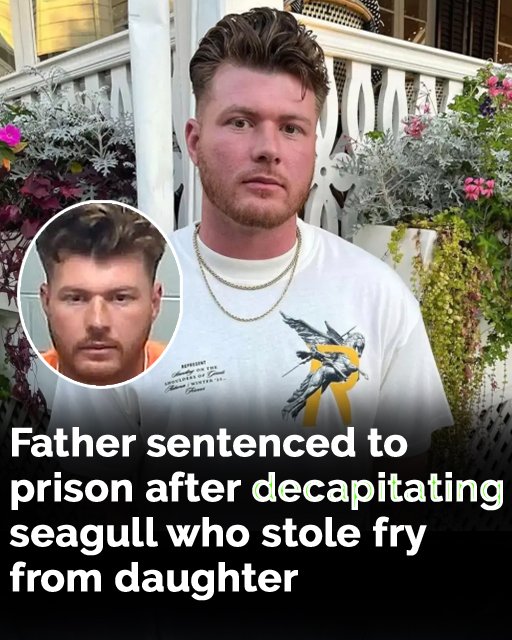
A disturbing incident at the Jersey Shore has reignited a fierce national debate over animal cruelty laws, judicial discretion, and the balance between punishment and rehabilitation. At the center of the controversy is 30-year-old Franklin Ziegler, whose actions on a crowded boardwalk shocked witnesses and drew widespread public outrage—yet ultimately resulted in a sentence many critics say falls far short of justice.
The incident took place on July 6, 2024, at the North Wildwood Boardwalk near Morey’s Piers and Beachfront Water Parks, a popular summer destination filled with families, tourists, and children. According to witnesses, the situation escalated rapidly when a seagull attempted to snatch a French fry from Ziegler’s daughter. What might have been dismissed as a common nuisance at a beachside location instead turned into a moment of violence that few present will soon forget.
Bystanders described a chaotic and deeply unsettling scene. In full public view, Ziegler reacted by killing the bird in a manner that many witnesses later called shocking and traumatic. The act unfolded in front of families and young children, some of whom reportedly began crying or were quickly ushered away by their parents. The suddenness and severity of the violence left a lasting impression on those who saw it.
What followed added to the distress. Witnesses reported that Ziegler then held the lifeless body of the seagull and approached nearby staff, asking for a trash bag. For many, this detail underscored what they perceived as a lack of remorse or awareness of the gravity of his actions. Authorities were called to the scene almost immediately, as multiple onlookers expressed concern, anger, and emotional distress.
Law enforcement responded, and Ziegler was later charged with several offenses, including third-degree animal cruelty. The case quickly gained traction beyond the local community, fueled by social media, news coverage, and advocacy groups calling for accountability.
When the case reached court, Ziegler ultimately pleaded guilty. His sentence included 263 days in jail—credited as time already served—along with five years of parole and $155 in fines. However, the most controversial aspect of the outcome was the decision to place him in a recovery court program rather than sentencing him to state prison.
Recovery court is a specialized form of supervised probation designed for individuals whose criminal behavior may be linked to substance abuse or underlying behavioral issues. Participants are typically required to undergo treatment, attend regular check-ins, and comply with strict conditions aimed at rehabilitation rather than punishment.
Ziegler’s attorney confirmed that he would participate in outpatient treatment as part of this program. Supporters of recovery court argue that it offers a more effective long-term solution by addressing root causes rather than focusing solely on incarceration. They point to studies suggesting that such programs can reduce recidivism and help individuals reintegrate into society.
However, in this case, the decision has sparked intense backlash.
Animal welfare organizations were among the most vocal critics. Groups such as In Defense of Animals condemned the sentence as far too lenient, arguing that it fails to reflect the severity of the act and the harm caused—not only to the animal but also to the community that witnessed it. Senior campaigner Doll Stanley described the incident as “a brutal act of cruelty committed in broad daylight,” emphasizing the need for stronger consequences to deter similar behavior.
Critics also point to a broader body of research linking animal cruelty to other forms of violence. Studies in psychology and criminology have long suggested that individuals who commit acts of violence against animals may be at higher risk of engaging in violent behavior toward humans. For many advocates, this connection underscores the importance of taking such cases seriously and imposing penalties that reflect their potential implications.
The public nature of the incident has further intensified concerns. Unlike cases that occur in private or out of view, this act took place in a crowded, family-oriented environment. Witnesses, including children, were exposed to a sudden and graphic act of violence, raising questions about public safety and the psychological impact on those present.
Some observers argue that the sentence sends the wrong message—that even highly visible and disturbing acts of cruelty may not result in significant legal consequences. They worry that this could undermine public confidence in the justice system and weaken deterrence.
On the other hand, there are those who defend the court’s decision, emphasizing the importance of rehabilitation over punishment. They argue that if substance abuse or other underlying issues played a role in Ziegler’s behavior, addressing those issues directly may be more effective in preventing future incidents than incarceration alone.
Proponents of this view highlight the structured nature of recovery court programs. Participants are closely monitored, required to adhere to strict guidelines, and subject to consequences if they fail to comply. In this sense, they argue, the program is not a lenient alternative but a different form of accountability—one that seeks to change behavior rather than simply punish it.
Still, the debate remains deeply polarized.
For many, the central question is not whether rehabilitation is valuable, but whether it is appropriate in this particular case. The combination of the act’s severity, its public setting, and its emotional impact has led some to conclude that a stronger punitive response was warranted.
Legal experts note that sentencing decisions often involve a complex balancing of factors, including the nature of the offense, the defendant’s background, and the goals of the justice system. In this instance, the court appears to have placed significant weight on the potential for rehabilitation.
Yet the controversy highlights a broader issue: the evolving standards around animal cruelty and how such cases are treated within the legal system. As public awareness and concern for animal welfare continue to grow, there is increasing pressure on lawmakers and courts to ensure that penalties align with societal expectations.
The case of Franklin Ziegler has become a focal point for this conversation. It has prompted renewed calls for stricter animal cruelty laws, clearer sentencing guidelines, and greater consideration of the broader impact of such acts.
In the aftermath, the community continues to grapple with what happened. For those who witnessed the incident, the memory remains vivid. For advocacy groups, the case serves as a rallying point for reform. And for the legal system, it raises difficult questions about how best to balance justice, deterrence, and rehabilitation.
Ultimately, the debate sparked by this case is unlikely to fade quickly. It touches on fundamental issues about how society defines cruelty, how it responds to violence, and what it expects from its justice system.
As opinions remain divided, one thing is clear: this incident has left a lasting mark—not only on those who witnessed it, but on the broader conversation about accountability and compassion in modern society.