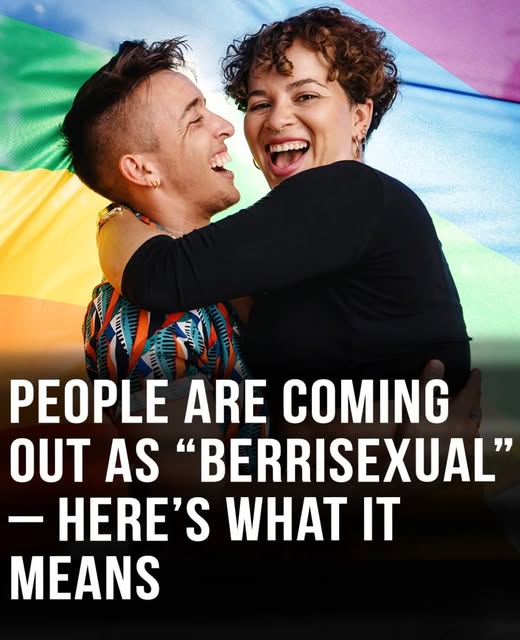
Berrisexuality is a relatively new micro-label used within LGBTQ+ communities to describe a specific pattern of attraction. People who identify as berrisexual often describe themselves as capable of being attracted to all genders, similar to those who identify as bisexual or pansexual. However, what distinguishes berrisexuality is the presence of a noticeably stronger, more frequent, or more emotionally resonant attraction toward women, feminine-presenting individuals, and androgynous people.
Importantly, attraction to men or masculine-aligned individuals is not absent. Rather, it may feel lighter, less common, or secondary in intensity. For some, this imbalance has always been part of their internal experience. They may have recognized that while their capacity for attraction spans genders, their patterns of desire consistently lean in a particular direction. Over time, this nuance can feel difficult to explain using broader labels that do not account for differences in frequency or intensity.
Traditional terms like bisexual or pansexual are intentionally expansive. Bisexuality is commonly defined as attraction to more than one gender, while pansexuality often emphasizes attraction regardless of gender. For many people, these labels are affirming and sufficient. But for others, they can feel slightly too broad — as though they flatten a detailed inner landscape into a simplified summary. Someone might think, “Yes, I’m attracted to multiple genders, but that doesn’t fully describe how my attraction actually works.” Berrisexuality emerges as a way to articulate that subtle internal weighting without denying the broader spectrum of attraction.
Online communities have played a significant role in shaping and spreading awareness of micro-labels like berrisexual. Platforms such as Reddit, Tumblr, and various queer wikis often serve as spaces where people experiment with language and share personal reflections. Many individuals who encounter the term describe a sense of relief. Finding a word that mirrors one’s lived experience can feel validating. It can ease the pressure of trying to explain complex feelings in conversations about identity. As one user wrote in an online discussion, discovering the term felt like no longer having to “round up or round down” their attraction to fit a more familiar category.
At the same time, there is ongoing conversation within LGBTQ+ spaces about the role of micro-labels. Some people embrace them as helpful tools for precision and self-understanding. Others prefer broader terms, emphasizing unity and simplicity. Many stress that labels are optional and personal. No one is required to adopt a micro-label in order to legitimize their experience. Identity language is meant to serve the individual, not restrict them.
For those who choose it, berrisexuality offers language that acknowledges nuance rather than smoothing it over. It allows someone to say, “My attraction is wide, but it has a pattern.” It honors the reality that attraction is not always evenly distributed or static. Human desire can shift, intensify, ebb, or cluster in ways that feel deeply personal.
Ultimately, berrisexuality reflects a broader trend within queer communities: the ongoing effort to refine language so that it better reflects lived experience. Whether someone adopts this term or not, its existence underscores a central truth about identity — that it is layered, evolving, and deserving of words that feel authentic. For those who have long felt “almost but not quite” at home in broader categories, berrisexuality can offer something meaningful: recognition, specificity, and the comfort of being understood on one’s own terms.