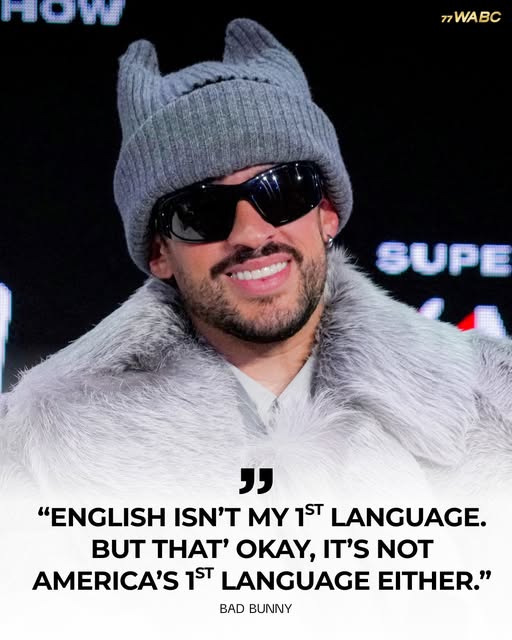
When Bad Bunny quipped, “English isn’t my first language — but that’s okay, it’s not America’s first language either,” he wasn’t just making a joke. He was articulating a profound truth about identity, culture, and belonging in a nation that has always been a mosaic of voices and experiences. That line — simple, sharp, and sincere — became a defining moment of the conversation around his historic Super Bowl 2026 halftime show.
A Statement Rooted in Identity
Bad Bunny’s words cut straight to the heart of a debate that has followed him for years: language, authenticity, and what it means to be American. Born Benito Antonio Martínez Ocasio in Vega Baja, Puerto Rico, he grew up speaking Spanish, just like millions of Latinos in the U.S. and around the world. Despite being a U.S. citizen by birth, that part of his identity — Spanish as his first language — is inseparable from who he is as a person and as an artist.
When critics suggested that a Spanish-language artist didn’t “fit” on one of the biggest stages in American entertainment, Bad Bunny did not back down. Instead, with that one remark, he reframed the conversation: language doesn’t define worth, nor does it define belonging.
America’s Linguistic Reality
The remark resonated because it tapped into a wider reality that many Americans live every day. Contrary to popular assumptions, the United States has no official language at the federal level — English is dominant, but not legally “the first” or only language spoken here. Spanish, Chinese, Tagalog, Vietnamese, Arabic, and countless Indigenous languages are part of the nation’s linguistic landscape.
By saying that English isn’t America’s first language either, Bad Bunny was pointing out something most people take for granted: America has always been multilingual, from Indigenous languages long predating European colonization to the waves of immigrant voices that continue to shape the country today.
A Defining Super Bowl Moment
Bad Bunny’s remark wasn’t made in isolation. It came during the press run for his Super Bowl halftime show — a performance that became one of the most talked-about cultural moments of 2026. The show was almost entirely in Spanish, celebrating Puerto Rican culture, beats, and rhythms without translation. And yet, it resonated with a massive U.S. and global audience.
At one point in the show, Bad Bunny even spoke his first and only English words: “God bless America.” Then he went on to name every Latin American country before circling back to include the U.S. and Canada — a list that visually and verbally redefined “America” not as a single country, but as a shared hemisphere of cultures and people.
For some critics, this was controversial. For many others, it was a celebration of inclusion — an acknowledgment that the “American experience” is broader and more diverse than traditional narratives often allow.
Why the Quote Matters
What makes Bad Bunny’s line powerful is its simplicity. It challenges assumptions without hostility. It highlights inclusion without erasing identity. And it reframes American identity in a way that doesn’t diminish anyone.
Language is deeply personal. For many immigrants and descendants of immigrants, speaking a language other than English is part of their story, not a point of shame. That perspective has often been met with resistance in mainstream U.S. discourse, where English is frequently treated as a default or requirement for legitimacy. Bad Bunny turned that notion on its head, reminding audiences that language diversity is part of the nation’s DNA.
Beyond Entertainment: A Cultural Marker
Bad Bunny is a pop star, not a politician. Yet his comment points to broader cultural dynamics affecting the U.S. today. Debates over immigration, identity, patriotism, and what it means to be “American” have grown increasingly polarized. In that context, a musician — through a simple statement about language — helped shift the conversation toward a more inclusive understanding of identity.
Rather than trying to fit into a narrow mold, Bad Bunny stood proudly within his own. He didn’t apologize for singing in Spanish on one of the biggest stages in American entertainment; he celebrated it. And millions of people responded — not because they felt they had to, but because they saw themselves reflected in that authenticity.
The Power of Representation
Representation matters. When audiences see someone succeed while fully embracing their identity, it sends a message: you don’t have to erase who you are to belong. Bad Bunny’s rise to global fame while staying true to his roots is emblematic of a shift in cultural norms — a shift that recognizes that the fabric of American culture is enriched, not threatened, by diversity.
That is why the remark about language resonated far beyond a catchy quote. It spoke to lived experience — for Latino Americans, immigrants, bilingual communities, and anyone who has ever felt defined by more than one culture.
Challenging Assumptions, Expanding Definitions
When Bad Bunny said “it’s okay” that English isn’t his first language, he was also implicitly challenging the assumption that American culture must conform to a single linguistic framework. American identity is not monolithic — it’s shaped by countless influences and voices. And language, far from being a barrier, is part of that richness.
In a world increasingly interconnected yet often divided, there is something radical about embracing complexity instead of simplifying identity. Bad Bunny’s remark may have been delivered with a wink, but it carries a substantive truth: belonging doesn’t require conformity.
A Legacy Beyond Music
Bad Bunny’s statement is more than a memorable line — it’s a cultural marker for a moment when audiences across language lines found common ground in music, identity, and shared humanity. Whether one agrees with every artistic choice he makes or not, it’s clear that his voice — both literally and symbolically — is reshaping how we think about language, culture, and what it means to be American in the 21st century.
As conversations about identity and inclusion continue to evolve, Bad Bunny’s words remind us that America is not defined by a single language — it is defined by the diversity of its people.