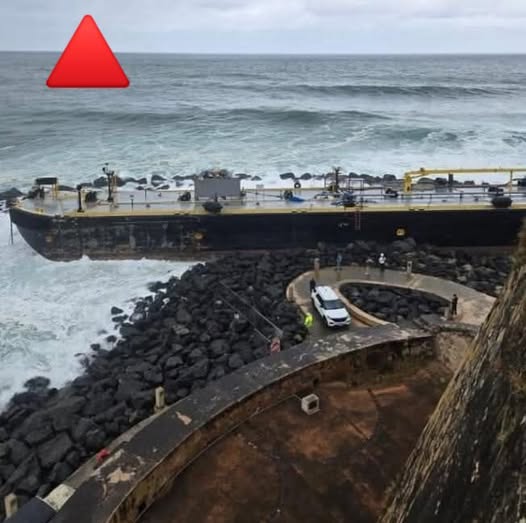
A fuel barge ran aground near the shoreline breakwater in front of Castillo San Felipe del Morro at the entrance to San Juan Bay, drawing attention from maritime authorities, local officials, and residents. The incident, which occurred in an area known for both its historic significance and active vessel traffic, prompted a coordinated response to ensure safety, environmental protection, and navigational awareness.
According to official sources, the vessel became grounded along the rocky breakwater near El Morro, one of Puerto Rico’s most iconic landmarks. The sight of a large fuel barge positioned so close to the historic fort and shoreline quickly circulated among onlookers and on social media, raising questions about potential risks and the cause of the grounding. While the visual impact of the situation was striking, early statements from those involved emphasized that the immediate risk level remained low.
Alfredo Santaella, identified as president of Harbor Bunkering and owner of the vessel, stated that the situation does not pose an immediate threat to navigation or to the marine environment. This reassurance helped calm initial public concerns, particularly given the vessel’s role as a fuel barge and the sensitive nature of coastal ecosystems. Fuel barges carry large quantities of petroleum products, and any incident involving them naturally raises fears of leaks or spills. However, as of the latest updates, no fuel discharge or environmental contamination has been reported.
Maritime authorities, including personnel from the United States Coast Guard and other relevant agencies, responded to the scene to monitor the vessel and assess the circumstances surrounding the grounding. Their presence is standard procedure in maritime incidents, especially those involving commercial vessels and potential environmental risk. Teams on-site are reportedly evaluating hull integrity, vessel stability, and surrounding water conditions before any refloating operations begin.
Refloating a grounded barge is a delicate and highly technical process. It typically involves inspecting the vessel for damage, calculating tides and currents, and sometimes using tugboats or specialized equipment to safely move the barge back into deeper water. Authorities must also consider weather and sea conditions, as rough waters can complicate recovery efforts and increase risk. In a location like the entrance to San Juan Bay — where currents, waves, and vessel traffic intersect — planning must be precise.
The area near Castillo San Felipe del Morro is not only historically important but also navigationally significant. San Juan Bay serves as a major maritime gateway, accommodating cargo ships, cruise vessels, and local marine traffic. Even when an incident poses no direct hazard, authorities often advise caution to mariners in the vicinity. In this case, officials have urged vessels transiting the area to remain alert and proceed carefully while monitoring operations continue.
Local residents and visitors alike reacted with surprise at the unusual sight of a barge so close to the breakwater. El Morro is a UNESCO-recognized historic site and a symbol of Puerto Rico’s colonial history, attracting tourists year-round. The juxtaposition of modern maritime industry and centuries-old fortifications served as a reminder of how historic and commercial maritime worlds coexist in San Juan.
While investigations are still underway, maritime incidents like this can occur for a variety of reasons. Common factors include mechanical issues, navigational miscalculations, sudden weather changes, or strong currents. Determining the exact cause requires reviewing vessel logs, communication records, and environmental conditions at the time of the event. Officials typically refrain from speculation until a formal review is complete.
Importantly, no injuries have been reported in connection with the grounding. The absence of injuries and spills significantly reduces the severity classification of the incident, though authorities still treat any fuel-related vessel grounding with caution. Prevention of secondary issues — such as hull stress, shifting cargo, or weather-related complications — remains a priority.
Environmental monitoring is also a key focus. Even when no spill is visible, response teams often deploy precautionary measures to ensure that surrounding waters remain protected. Puerto Rico’s coastal ecosystems are valuable both ecologically and economically, supporting fisheries, tourism, and recreation. Quick response and careful oversight help minimize any potential impact.
This event highlights the broader reality of maritime logistics in island regions. Puerto Rico depends heavily on marine transport for fuel, goods, and supplies. Fuel barges and tankers play a critical role in energy distribution across the island. While such operations are generally safe and well-regulated, incidents underscore the importance of strict navigation protocols and rapid response systems.
As recovery planning continues, coordination between private vessel owners and government agencies will be essential. Successful refloating without environmental harm would mark a positive outcome and demonstrate effective maritime safety procedures. Authorities are expected to provide updates as assessments progress and as next steps are determined.
For now, officials continue to monitor the situation closely. Mariners are advised to stay informed through official navigation notices, and the public is encouraged to rely on verified updates rather than speculation. Situations like this often evolve as more technical evaluations are completed.
Though visually dramatic, the grounding near El Morro currently appears to be under control, with no immediate danger reported. The coming days will likely focus on safe removal of the vessel, investigation into the cause, and ensuring the continued protection of San Juan Bay’s waters and shoreline.
As with any developing maritime story, clarity comes with time. What remains clear is that rapid coordination and transparent communication help maintain safety and public confidence whenever unexpected events occur along busy and historic waterways like those of San Juan.