On February 8, 2026, music history was made at Super Bowl LX’s Apple Music Halftime Show at Levi’s Stadium in Santa Clara, California. What began as a chart-topping, record-breaking performance quickly became a cultural milestone — not just for sports or entertainment, but for global identity, pride, and representation.
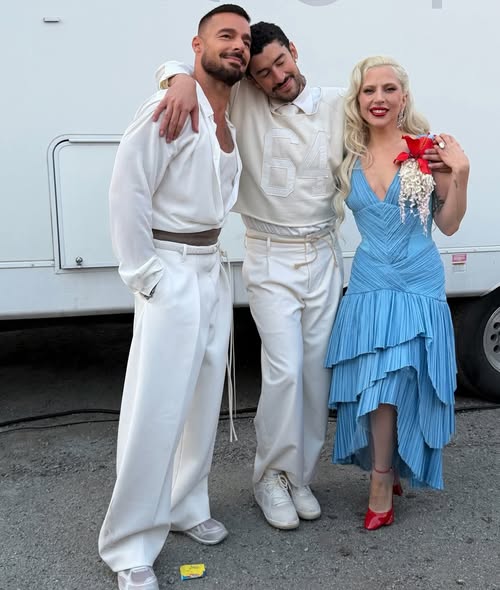
Among the many moments spectators will never forget was the sight captured in your photo — three icons from different generations and backgrounds standing side by side: Ricky Martin, Bad Bunny, and Lady Gaga — each embodying music’s evolving and inclusive spirit.
🎤 Setting the Stage: Bad Bunny’s Historic Headline
Bad Bunny — born Benito Antonio Martínez Ocasio — made history as the first solo Latin artist to headline the Super Bowl halftime show, delivering nearly a 13-minute set almost entirely in Spanish. This bold choice marked a significant shift for an event watched by millions worldwide.
From the outset, the performance was deeply rooted in Puerto Rican culture, opening with vibrant scenes of a sugar cane field and a bustling barrio. Iconic tracks such as “Tití Me Preguntó”, “Yo Perreo Sola”, and “El Apagón” were interwoven with rich storytelling and symbolic visual elements paying homage to the island’s history and people.
Bad Bunny didn’t just perform — he created a world on the field, celebrating Latin music and identity with every beat and lyric. In an era where global music increasingly reflects diverse cultures, his set stood as a testament to how language and tradition can command one of the biggest stages on Earth.
🌟 Iconic Guest Appearances
As part of the production — and to the delight of fans — two of music’s most influential stars joined Bad Bunny:
🎶 Ricky Martin
A trailblazer for Latin pop internationally, Ricky Martin took the stage to perform “Lo Que Le Pasó a Hawaii.” This song — a collaboration with Bad Bunny — explores the fragility of culture and identity, touching on themes of change, globalization, and heritage.
For Martin himself, the moment was deeply emotional. After the show, he shared that he needed “several hours to process” the gravity of the appearance — a reflection of how meaningful the collaboration was for him personally and culturally.
🎤 Lady Gaga
Lady Gaga’s cameo was another standout, as she delivered a salsa rendition of “Die With a Smile,” showcasing not only her vocal prowess but her versatility as an artist. Her performance blended seamlessly with the show’s celebratory and boundary-breaking tone, reinforcing unity and artistic freedom.
Together, Bad Bunny, Martin, and Gaga represented three unique cutures and eras of music: Puerto Rican reggaeton and Latin trap, Latin pop that conquered global charts long before Latin music became mainstream, and avant-pop bravado that defies genre limits.
📸 A Celebratory Aftermath
The image you shared — showing a relaxed, joyful moment between Bad Bunny, Ricky Martin, and Lady Gaga after the performance — captures more than just post-show bliss. It’s a snapshot of mutual respect and generational collaboration.
Behind the scenes, videos and photos circulated of the trio hugging, laughing, and soaking in the moment — a striking contrast to the high-energy spectacle fans had just witnessed. For many, that camaraderie reflected something bigger than performance artistry: a celebration of unity, cultural pride, and shared success.
🎉 What Made This Show So Special
🏆 A Celebration of Culture Over Conformity
What set this halftime show apart was its unapologetic embrace of language and identity. Performing almost entirely in Spanish at America’s most watched broadcast — with guest stars who represent such breadth of cultural influence — sent a clear message: music transcends language, and inclusion isn’t just acceptable — it’s powerful.
🎥 Visual Storytelling That Resonated
From sugar cane fields and house parties to a symbolic wedding and scenes of everyday life, the show was more than a concert — it was a cinematic journey. These visual cues celebrated Puerto Rican heritage, communal resilience, and collective joy.
🎶 Musical Diversity & Legacy
The show wasn’t just about Bad Bunny’s hits. It honored reggaeton’s roots with nods to Daddy Yankee and Don Omar, introduced new pop interpretations with Gaga, and emphasized continuity with Martin’s Latin pop legacy.
📊 Reception and Impact
Domestically, the performance attracted an impressive 128.2 million viewers, making it one of the most watched halftime shows in history.
While some conservative commentators criticized aspects of the show — particularly its language choice and cultural messaging — the broader response from artists and audiences was overwhelmingly positive. Celebrities praised the performance for its vibrance, inclusivity, and authenticity.
💬 A Cultural Turning Point
Whether celebrated as an artistic triumph or discussed as a cultural flashpoint, the 2026 Super Bowl halftime show will be remembered as a defining moment in modern entertainment. It highlighted how music can be both deeply personal and universally unifying — and how stars from different generations and styles can come together to create something transcendent.
The image you provided — a candid moment of laughter and connection between Bad Bunny, Ricky Martin, and Lady Gaga — encapsulates this spirit perfectly: three icons, each a legend in their own right, united by music, mutual respect, and a shared moment on one of the world’s biggest stages.
If you want, I can also write a shorter photo caption, a social media post, or a journalistic snippet for a website based on this performance!