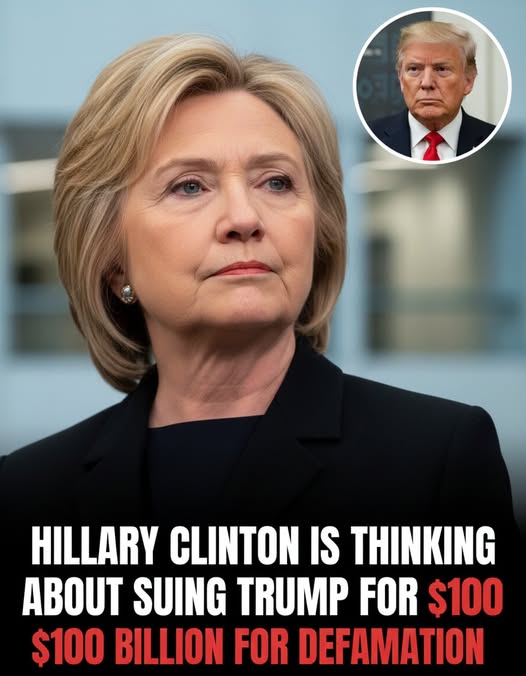
A dramatic image is circulating online with a headline-style claim: “Hillary Clinton is thinking about suing Trump for $100 billion for defamation.” Variations of the same message have appeared across social platforms, often framed as “BREAKING” news but without links to court filings, statements from attorneys, or reporting from established outlets.
That gap matters, because defamation lawsuits involving high-profile political figures—especially anything hinting at a nine- or ten-figure demand—don’t usually stay “internet-only.” They tend to show up quickly in public records and mainstream reporting, if only because the parties involved are famous and the allegations can affect reputations, campaigns, fundraising, and governance.
Where the $100 billion claim appears to be coming from
So far, the clearest “sources” behind the $100 billion figure are posts and reposts on social media, not verified documents. In other words, the claim is being repeated as a claim, but repetition itself isn’t evidence.
It’s also worth noting how these viral graphics are built: a recognizable photo, a second face in a corner bubble, bold text, and a huge dollar amount. The format mimics legitimate breaking-news cards, but it’s easy to produce with basic editing tools—and it spreads fast precisely because it triggers outrage, satisfaction, or curiosity before people ask, “Wait, did anyone credible report this?”
Would a $100 billion defamation lawsuit be realistic?
In U.S. defamation law, the number in a demand letter or complaint can be almost anything, but plausibility is another story. For public figures, the burden is high: under the “actual malice” standard from New York Times Co. v. Sullivan, a public official/public figure generally must show a false statement of fact was made knowing it was false or with reckless disregard for the truth.
Even if a plaintiff can prove liability, damages at the $100 billion level would be extraordinary. Courts and juries look for evidence of real-world harm: reputational injury, emotional distress, and (in some cases) punitive damages meant to punish especially egregious conduct. A figure that large would invite intense scrutiny: What measurable harm equals $100 billion? What causal chain connects specific statements to that harm? How would a court treat First Amendment protections, especially in the rough-and-tumble arena of politics?
That doesn’t mean defamation damages can’t be large. In a prominent recent example, a federal appeals court upheld an $83.3 million defamation judgment against Trump in the case brought by writer E. Jean Carroll. But even that eye-popping award is still nowhere near $100 billion—and it followed years of litigation, specific statements, and detailed evidence about harm and the scale of attacks.
The real (documented) Trump–Clinton legal backdrop
There is recent, well-documented litigation tying Trump and Clinton together—but it runs in the opposite direction of the meme. Trump previously sued Clinton and various others in a sprawling case that a federal judge dismissed, and the judge sanctioned Trump and his attorney, ordering close to $1 million in penalties.
Later, an appellate court upheld that penalty.
Those are concrete, reportable developments: they come with court opinions, sanctions orders, and coverage from established outlets. They’re also an important reminder that high-profile political lawsuits can backfire—especially if a judge concludes claims are legally or factually baseless.
Why these “BREAKING” lawsuit memes spread so well
A claim like “$100 billion defamation lawsuit” is tailor-made for virality:
- It’s simple. No nuance, no legal details, just a punchy villain-vs-villain narrative.
- It’s emotionally satisfying to one side and enraging to the other—both reactions drive shares.
- It sounds plausible at a glance because defamation lawsuits are constantly in the news, including cases involving Trump and large sums.
- It doesn’t require proof to travel. People share the feeling of the story, not the documentation.
But documentation is exactly what separates “a rumor formatted like news” from news.
How to quickly sanity-check claims like this
If you want to turn this image into an article that adds value rather than amplifies misinformation, build your piece around verification. Here’s a fast checklist readers can follow:
- Look for a primary source. A court filing, a statement from counsel, or an on-record quote.
- Check reputable outlets. If it’s truly a major political lawsuit, outlets like Reuters or Associated Press typically have something—especially with a number as explosive as $100 billion.
- Watch for “reportedly” with no reporting. Many posts say “reportedly” and then cite… nothing.
- Be wary of perfect outrage bait. Giant numbers + familiar enemies + “BREAKING” = classic engagement trap.
- Search the exact phrase. If results are mostly social posts repeating each other, that’s a red flag.
Bottom line
Based on what can be verified from credible reporting and court-related coverage, the “Hillary Clinton is thinking about suing Trump for $100 billion” claim appears to be a social-media rumor packaged as a news graphic—not a documented legal action.
If you’re using this image as a prompt for a 1,000-word piece, the strongest—and most responsible—angle is a fact-check/analysis article: explain what the meme claims, show what reputable reporting does confirm about actual Trump–Clinton litigation and defamation standards, and walk readers through why the $100 billion figure is a tell.
If you want, I can rewrite the article in a specific style (tabloid, neutral newsroom, op-ed, or social-media blog tone) while keeping it grounded in verifiable facts.