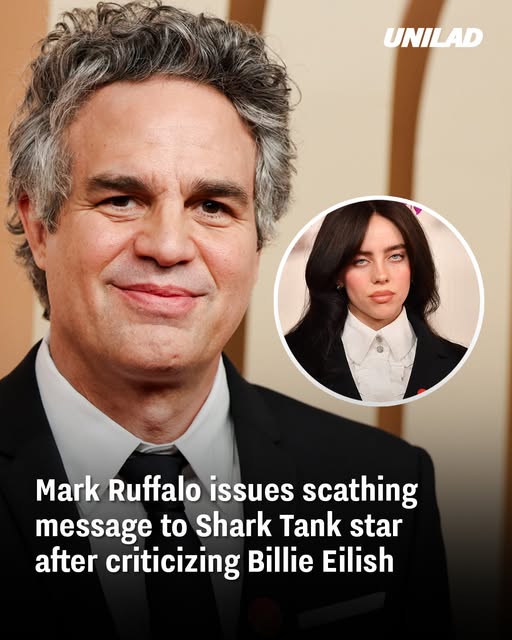
A fresh celebrity clash has lit up social media after Mark Ruffalo publicly blasted Kevin O’Leary—one of the best-known faces from Shark Tank—following O’Leary’s criticism of Billie Eilish and her political remarks at the Grammy Awards.
The headline-making moment wasn’t subtle: Ruffalo didn’t just disagree—he went straight for the jugular, telling O’Leary to “STFU” in a blunt Threads response that quickly spread across entertainment news and viral pages, including UNILAD.
How it started: Billie Eilish’s speech and the “stay in your lane” backlash
The controversy traces back to Eilish using her Grammys spotlight to denounce U.S. immigration enforcement—specifically ICE—framing her comments as a moral and political statement.
That kind of message is exactly the sort of thing that reliably triggers a familiar debate: Should entertainers speak on politics at all? Supporters argue artists have platforms and a right—maybe even a responsibility—to use them. Critics argue celebrities should keep the show “about the art” and avoid alienating audiences who came for entertainment, not activism.
O’Leary jumped into that long-running argument in a very O’Leary way—direct, provocative, and built for TV. In appearances covered by multiple outlets, he warned that political comments can cost artists fans and money, and he pushed the classic line that celebrities should “shut your mouth” and “just entertain.”
Whether you see that as practical advice or arrogant lecturing depends on your taste—but either way, it was enough to set off a chain reaction.
Ruffalo’s response: not polite, not cautious, and definitely not quiet
Ruffalo’s pushback wasn’t a long essay. It was a punch. According to coverage of the exchange, he told O’Leary “Why don’t you STFU?” and then went further—accusing him of hypocrisy and a “double standard,” essentially saying: you show up on TV to talk about everything, but you attack a musician for speaking her mind.
He also framed Eilish as an “artist” whose message resonates globally, implying O’Leary was punching down—or at least talking out of turn—by scolding a performer for saying what she believes.
And, in a detail that gave entertainment writers extra fuel, Ruffalo reportedly referenced O’Leary’s acting cameo in Marty Supreme—a pop-culture jab that turned the whole clash into something more memeable than a standard political debate.
Why this moment went viral
This story spread fast for a few reasons:
1) It hits a cultural pressure point.
Celebrity activism is one of those topics that people treat like a personality test. Your reaction often says more about your politics and worldview than about the celebrity involved.
2) The language was shock-value simple.
A single profanity-laced line from a well-known actor is “perfect internet content.” You don’t need context to share it, and it fits neatly into a screenshot.
3) It’s a clash of archetypes.
O’Leary has a public persona built around tough talk and “brutal honesty.” Ruffalo is known for outspoken progressive politics and advocacy. Put those two energies in the same frame and the internet does what it always does: chooses sides, amplifies the heat, and turns nuance into a team sport.
The bigger fight underneath: who “gets” to speak?
Strip away the celebrity names and you’re left with a deeper argument about power and permission.
O’Leary’s stance—at least as reported—leans on a market logic: if you want mass appeal, don’t polarize the audience; you’re selling entertainment.
Ruffalo’s counter is closer to a civic logic: artists are citizens, platforms matter, and telling people to shut up is its own kind of political act.
It’s also worth noting the asymmetry in the “stay in your lane” argument. It often lands on musicians and actors—yet political commentary from TV personalities, business figures, and pundits is treated as normal, even expected. That tension is exactly what Ruffalo seemed to be calling out when he implied O’Leary dishes opinions constantly while scolding others for doing the same.
Is Ruffalo’s tone helping—or hurting—his point?
A fair criticism is that telling someone to “STFU” doesn’t exactly invite thoughtful dialogue. It’s a dunk, not a discussion.
But that’s also why it worked. Modern public debates—especially online—often reward clarity over complexity and emotion over civility. Ruffalo’s response was built for that environment: short, sharp, and impossible to misread.
Whether you think that’s good for society is a separate question. But as a communication tactic, it’s undeniably effective—especially when your goal is to show solidarity with the person being targeted and signal you’re not interested in “respectability” arguments.
What happens next
These flare-ups usually follow a predictable arc:
- A quote goes viral (Eilish / O’Leary).
- A celebrity counterpunch escalates it (Ruffalo).
- The internet splits into camps.
- More outlets summarize the summaries.
- And then it fades—until the next awards show, the next political moment, or the next clip designed to trigger outrage.
Still, the incident underscores something real: major cultural conversations now happen in public, in fragments, and at maximum volume. The line between entertainment, politics, and business commentary isn’t just blurred—it’s basically gone.
And in that world, it makes sense that artists like Billie Eilish will keep speaking, investors like Kevin O’Leary will keep criticizing, and actors like Mark Ruffalo will keep clapping back—sometimes with nuance, sometimes with a verbal flamethrower.