Lunch rush in a café has its own kind of rhythm—orders called out, trays sliding across the counter, cups clinking, conversations overlapping like background music. It’s busy, loud, and fast. Most days, the goal is simple: keep the line moving, keep the coffee hot, keep everyone fed and happy. But every once in a while, something happens that slows time down. Something that makes you forget about the tickets piling up and reminds you why moments matter more than schedules.
That day started like any other. The café was full, the air smelled like grilled food and fresh fries, and I was behind the counter moving as quickly as I could. Then I saw him walk in.
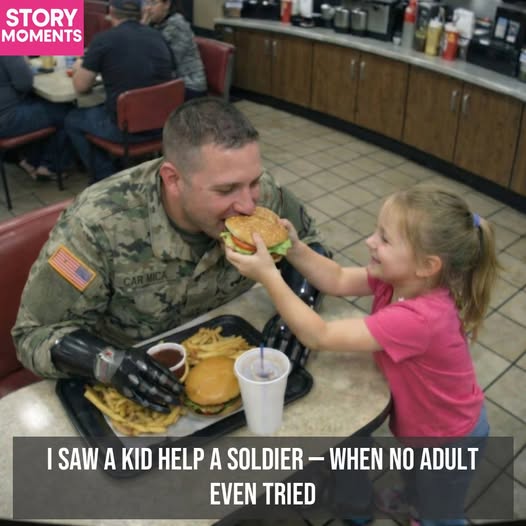
He wore an Army uniform and had two prosthetic arms.
He didn’t hesitate. He didn’t look around for attention. He moved with a calm confidence, the kind you recognize in people who’ve learned to adapt. He ordered like anyone else, carried his tray without trouble, and found a seat. The world didn’t stop for him, and he didn’t ask it to.
But when he sat down, the challenge wasn’t getting into the café or navigating the crowd—it was the burger.
He couldn’t pick it up.
It wasn’t dramatic. There was no scene, no frustration thrown into the air. It was just a quiet reality: two hands that weren’t built for gripping a sandwich.
And people noticed.
You could tell they noticed because heads turned. Eyes flicked over and away. Conversations slowed for half a second and then resumed. The room absorbed the moment and then tried to pretend it didn’t exist. Adults looked, registered the problem, and stayed in their seats.
No one stood up.
Not the couple near the window. Not the man at the next table. Not the group of coworkers sharing fries and laughing. Not one person moved—not because they were cruel, but because they were hesitant, unsure, or simply afraid of doing the wrong thing.
That’s the strange thing about kindness: sometimes the biggest barrier isn’t selfishness—it’s discomfort.
People don’t always know what’s appropriate. They don’t want to offend someone by assuming they need help. They worry about making it awkward. They wait for someone else to step in, because surely someone else will. And while they’re waiting, the moment passes, and the person in need is left alone with a problem that could be solved in seconds.
I was behind the counter, watching it unfold, feeling that tightness in my chest that comes when you want to help but you’re stuck serving customers and managing a line. I kept thinking, Someone will go over. Someone has to.
But no one did.
Then a child stood up.
Seven years old, maybe. Small frame. Bright, uncomplicated eyes. They didn’t look around for permission or approval. They didn’t appear to debate it internally. They simply did what adults often talk themselves out of doing.
They walked right over.
They lifted the burger with both hands—carefully, like it was important—and held it up for the soldier as if this was the most obvious solution in the world. No overthinking. No performance. No hesitation.
Just a simple, pure response to a simple, human need.
The soldier looked at the child and smiled—not with his mouth, but with his eyes. That kind of smile that carries gratitude, surprise, and respect all at once. He leaned forward and took a bite.
And the dining room went quiet.
Not an uncomfortable quiet, not the tense kind of silence you get when something bad happens. It was a warm quiet. The kind that wraps around a room and makes strangers look at each other differently. The kind that says, without words, We’re witnessing something good.
I’ve worked in that café for years. I’ve seen arguments over bills. I’ve seen couples celebrate anniversaries. I’ve seen first dates, breakups, job interviews, birthday gatherings, and customers who come in every morning like clockwork. I’ve seen every mood a public place can hold. But I’ve never seen kindness take over a room like it did that day.
Because what happened wasn’t only about a burger.
It was about what we choose to do when someone needs help.
The Moment Adults Missed
Adults tend to complicate kindness. We build mental obstacles:
- What if he doesn’t want help?
- What if I embarrass him?
- What if I do it wrong?
- What if someone else handles it?
Those thoughts can sound reasonable. Sometimes they even come from a respectful place. But they can also become excuses that keep us frozen.
That day, the soldier didn’t need anyone to make a speech. He didn’t need pity. He didn’t need a dramatic rescue. He just needed someone to hold a burger for 30 seconds.
And every adult who stayed seated missed the chance to be that someone.
The child didn’t miss it.
Kids are often closer to instinctive empathy. They see a need and respond. They don’t always feel the social weight of “appropriateness” that adults carry. They haven’t yet learned the habit of waiting for permission to be kind.
In that sense, the child wasn’t just helping the soldier—they were teaching the room.
The Quiet Power of Simple Compassion
The most powerful acts of kindness aren’t always big. They’re not always expensive. They don’t always come with applause. Often, they’re small, practical, and immediate. They solve a real problem in the simplest way possible.
That’s what made the moment so striking.
A burger. Two hands. One child. One soldier. One bite. A room changed.
And after that bite, something shifted. You could feel it. Faces softened. People stopped pretending they hadn’t noticed. Some smiled. Some looked down as if they were thinking, Why didn’t I do that? A few people seemed moved in the quiet, private way that makes you blink a little more than usual.
Kindness doesn’t just help the person receiving it—it reminds everyone watching what kind of human they want to be.
What I Took Home From That Day
When the lunch rush ended and the café returned to its usual noise, I couldn’t stop replaying the scene in my mind. Not because it was sentimental, but because it was honest.
It showed me something important: empathy isn’t complicated—our fear makes it complicated.
I don’t know the child’s name. I don’t know the soldier’s story. I only know what I saw: a moment where the simplest form of compassion became a mirror for everyone in the room.
And if I’m being honest, it also became a mirror for me.
Because even though I was working, even though I had reasons, I still felt that sting of realization: kindness is everyone’s responsibility. If we see a need and we can safely help, we should.
Not later. Not after someone else. Not when it feels less awkward.
Now.
A Question Worth Asking
That day made me think: How many moments like that happen around us every week? How many quiet needs are sitting right in front of us while we scroll, rush, or stay comfortably in our seats?
Sometimes “being a good person” isn’t about grand gestures. It’s about noticing, moving, and helping before the moment passes.
That seven-year-old didn’t change the whole world.
But they changed the whole room.
And maybe that’s how the world changes—one small act at a time, when someone chooses not to look away.
#kindness #empathy #humanmoments #everydayheroes #goodness #compassion #humankind #smallactsbigimpact #community #wholesomemoments #humanstories #inspiringstories #bethegood #fblifestyle