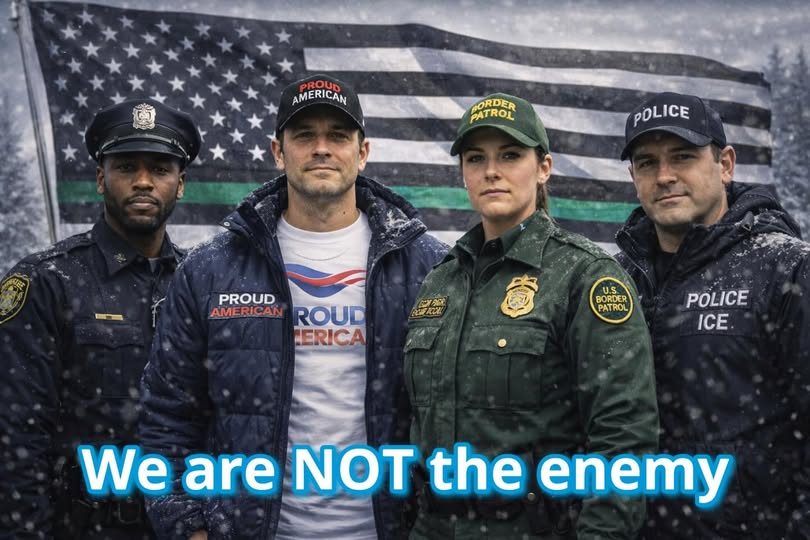
In recent years, conversations around law enforcement and immigration agencies have grown more polarized. Policies, incidents, and political rhetoric have all contributed to strong opinions on different sides. In this environment, it is easy for entire professions to be reduced to symbols. A badge can become a political statement; a uniform can become shorthand for a whole set of assumptions. Yet the daily reality is far more complex. Most officers and agents clock in, do their jobs, and go home to their families, much like teachers, doctors, or construction workers. They worry about their children, pay their bills, and hope to return safely at the end of a shift.
Seeing public servants as multidimensional people does not mean ignoring real concerns about policy or conduct. Democratic societies rely on accountability, transparency, and the ability to question authority. At the same time, healthy debate works best when it distinguishes between criticizing systems and dehumanizing individuals. When rhetoric turns any group into “the enemy,” it can erode trust and make constructive dialogue harder.
Law enforcement and border or immigration officers often operate in difficult circumstances. They may face unpredictable situations, make split-second decisions, and work long hours under stress. Many enter these careers out of a desire to serve, to provide stability for their families, or to contribute to public safety. Some are veterans transitioning from military service; others are second-generation officers following family traditions. Their motivations are diverse, but a common thread is a sense of duty.
Community safety is also a shared goal. Parents want their children to walk to school safely. Business owners want secure neighborhoods where customers feel comfortable. Residents want emergency calls answered quickly. Public servants are one piece of that broader safety ecosystem, alongside community leaders, social services, educators, and families themselves. No single group can create safe communities alone.
The idea that officers are “neighbors” is more than a slogan. In many places, they live in or near the communities they serve. Their kids attend local schools; they shop in the same stores and sit in the same traffic. This proximity can build understanding. Officers who know their communities personally may be better positioned to de-escalate conflicts, recognize local dynamics, and build relationships that prevent problems before they start.
At the same time, trust is not automatic—it is built over time. Positive everyday interactions matter: a respectful traffic stop, a helpful response to a call, a calm conversation in a tense moment. Small experiences accumulate into public perception. When people feel heard and treated fairly, trust grows. When they feel dismissed or mistreated, it shrinks. This is true for any institution, not just law enforcement.
Public servants also operate within policies and laws set by elected officials. They do not usually write the rules they enforce. That distinction is important in public discourse. People may strongly support or oppose certain laws or enforcement priorities, but the individuals implementing them are often following legal mandates and workplace requirements. Meaningful change, when desired, typically flows through legislation, courts, and civic engagement rather than personal hostility toward workers.
Gratitude, like in your caption with #thankyou and #staysafe, can play a role in morale. Many officers report that simple appreciation from community members helps balance the stress and risks of the job. Feeling valued can encourage professionalism and reinforce a service-oriented mindset. At the same time, appreciation and accountability are not opposites; communities can express thanks for service while still expecting high standards and ethical behavior.
Another often-overlooked dimension is the emotional toll of public safety work. Responding to accidents, crimes, and crises can expose officers to trauma. Departments increasingly recognize the need for mental health support, counseling, and peer programs. Supporting the well-being of public servants ultimately benefits the community too, because healthier officers tend to perform better and interact more positively with the public.
Media and social media shape perceptions as well. Viral videos of negative encounters can travel far and fast, sometimes without full context. Positive stories—quiet acts of help, successful interventions, mentorship—often receive less attention. This imbalance can skew public understanding. A balanced view acknowledges that problems can exist and deserve attention, while also recognizing that many interactions are routine and constructive.
The message “We are NOT the enemy” can be read as an invitation: to see public servants as part of the social fabric rather than outside it. It encourages a mindset where disagreement over policy does not automatically translate into personal animosity. In pluralistic societies, people will always hold different views about the right balance between security, liberty, enforcement, and reform. The challenge is to hold those debates without losing sight of each other’s humanity.
Strong communities tend to be built on mutual recognition. Residents recognize the role of public servants; public servants recognize the dignity and rights of residents. Dialogue, community programs, and local engagement can bridge gaps. When officers attend community events, speak with youth groups, or partner with local organizations, they become more than a uniform—they become a familiar face.
Ultimately, the idea that they are neighbors, parents, and public servants is a reminder of shared identity. Most people, regardless of politics, want safe neighborhoods, fair treatment, and opportunities for their families. Focusing on those common goals can lower the temperature of public conversations and open space for practical solutions.
Supporting those who serve and striving to improve the systems they work in do not have to be mutually exclusive. A mature society can do both: thank individuals for their service and push institutions toward their highest standards. When that balance is found, the phrase “not the enemy” becomes less of a defense and more of a simple statement of reality—we are all, in different roles, part of the same community.