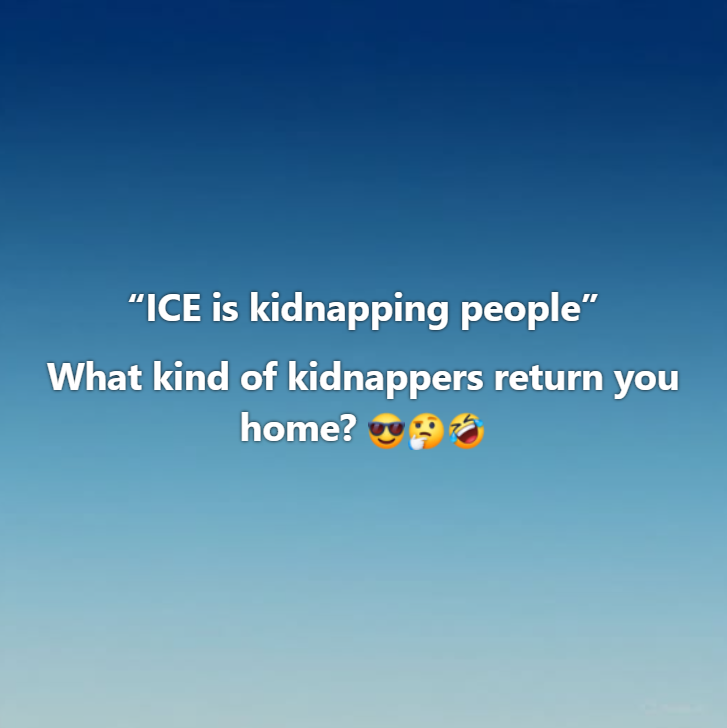
“ICE is kidnapping people” followed by the rhetorical question, “What kind of kidnappers return you home?” Framed with humor and emojis, the message uses irony to challenge a common accusation made in heated discussions about immigration enforcement in the United States. Despite its light tone, the statement sits on top of a very serious and deeply polarizing issue: how a country enforces its immigration laws and how that enforcement is perceived by different communities. At the center of the debate is U.S. Immigration and Customs Enforcement (ICE), the federal agency responsible for enforcing immigration laws within the country’s borders. Critics of ICE sometimes use the word “kidnapping” to describe arrests and detentions carried out by the agency, especially in cases where individuals are taken into custody without warning and separated from their families and communities. From this perspective, the suddenness, fear, and loss of control involved in such encounters can feel similar to an abduction.
Supporters of immigration enforcement reject that characterization. They argue that ICE officers are carrying out legally authorized arrests under existing laws, often following court orders or formal removal proceedings. From this viewpoint, describing enforcement as “kidnapping” is seen as emotionally charged language meant to delegitimize lawful government action. The meme’s rhetorical question—“What kind of kidnappers return you home?”—leans into this counterargument by pointing out that many immigration enforcement actions ultimately involve deportation, meaning the person is sent back to their country of origin rather than held indefinitely or harmed.
This clash of language highlights how word choice shapes public perception. Calling an arrest “kidnapping” emphasizes the experience of the person being detained: the fear, the lack of consent, and the feeling of being taken away by force. Calling it “enforcement” emphasizes the legal framework: laws passed by legislatures, orders issued by courts, and procedures carried out by authorized officers. Both descriptions focus on different aspects of the same event, and each carries strong emotional weight.
Humor, as used in the image, is a common way people engage with controversial topics online. By adding laughing and thinking emojis, the message invites readers to see the accusation as exaggerated or illogical. Memes compress complex policy debates into a single, shareable punchline. This makes them powerful tools for shaping narratives, but it also means nuance often gets lost. Immigration enforcement is not a single, uniform experience; outcomes vary widely depending on a person’s legal status, criminal history, asylum claims, family ties, and the policies in effect at the time.
For some people, deportation really does mean “going home” in a literal sense: returning to the country where they were born and hold citizenship. For others, especially those who have lived most of their lives in the United States, have U.S.-citizen children, or fled danger in their country of origin, being sent back may not feel like going home at all. It can mean being uprooted from the only community they truly know and placed in a country that feels foreign or unsafe. In those cases, the meme’s framing can sound dismissive of very real hardship.
The statement also touches on a broader philosophical question about borders and belonging. Every country maintains some form of immigration control, and most people accept that governments have the authority to decide who may enter and remain. At the same time, modern societies also wrestle with humanitarian obligations, economic realities, and the contributions of migrants. Tension arises when strict legal enforcement collides with individual stories that evoke sympathy and raise moral questions.
Public opinion on immigration enforcement tends to fall along a spectrum rather than into two neat camps. Some people favor very strict enforcement with few exceptions, emphasizing rule of law and national sovereignty. Others favor more permissive or reform-oriented approaches, emphasizing family unity, economic need, and protection for vulnerable populations. Many hold mixed views, supporting enforcement in principle but opposing specific practices they see as too harsh, such as workplace raids or detentions that affect long-settled families.
The meme’s effectiveness comes from its simplicity. By reframing the accusation in a single question, it encourages readers to reconsider the word “kidnapping.” But simplicity can also obscure important distinctions: between arrest and abduction, between deportation and exile, between legal authority and moral judgment. Real-world immigration cases involve courts, appeals, detention standards, international agreements, and sometimes discretionary decisions by officials.
Social media amplifies the most emotionally resonant framings on all sides. Phrases like “kidnapping” or, conversely, jokes that minimize the trauma of removal, travel faster and further than detailed explanations of immigration statutes or case law. This creates an environment where debates are often driven by slogans and counter-slogans rather than shared facts. Memes become shorthand for entire political positions.
Ultimately, the image reflects how polarized and language-driven the immigration conversation has become. Whether one sees ICE actions as necessary law enforcement or as unjust coercion often depends on underlying values about law, fairness, national identity, and human rights. The rhetorical question in the meme does not settle the debate; instead, it exposes the gap between two very different ways of interpreting the same set of actions.
A more productive discussion may start by acknowledging both the legality of enforcement and the human impact of how it is carried out. Recognizing that deportation can simultaneously be lawful, routine, traumatic, and, in some cases, life-altering allows for a conversation that goes beyond labels. Memes can open the door to that conversation by grabbing attention, but understanding the issue requires stepping past the punchline into the complex realities of migration, law, and lived experience.