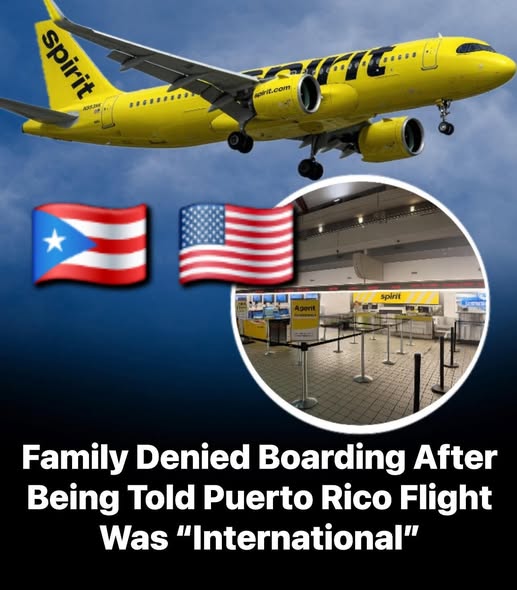
A family’s attempt to travel from California to San Juan, Puerto Rico, turned into a frustrating and costly ordeal—one that has since ignited widespread criticism and renewed conversations about airline training, cultural awareness, and basic travel regulations.
According to the family, they were denied boarding on a Spirit Airlines flight after airline staff insisted that their toddler required a passport because the flight was “international.” Despite repeated explanations from the parents that Puerto Rico is a U.S. territory and that flights from the mainland are legally classified as domestic, both a gate agent and a supervisor reportedly upheld the decision, preventing the family from boarding.
The child did not have a passport—because none is required.
A Basic Fact, Widely Misunderstood
Puerto Rico has been a U.S. territory since 1898. Residents of Puerto Rico are U.S. citizens, use the U.S. dollar, serve in the U.S. military, and travel freely between the island and the mainland United States. From an aviation and legal standpoint, flights between the continental U.S. and Puerto Rico are domestic flights, no different than traveling from California to Florida.
For domestic air travel within the United States:
- Adults may travel with a valid driver’s license or other acceptable ID
- Children under 18 are not required to present identification
This is not an obscure regulation. It is a foundational rule of U.S. air travel.
What the Family Says Happened
The parents, who are of Puerto Rican descent, stated that when they arrived at the gate, an airline agent informed them their toddler needed a passport. When they objected—politely explaining the domestic status of Puerto Rico—they were allegedly told that the flight was considered international and that the policy could not be overridden.
They asked for a supervisor. The supervisor, they say, repeated the same claim.
Despite showing documentation and explaining federal travel rules, the family was reportedly denied boarding entirely. With limited options and urgent travel needs, they were forced to purchase last-minute tickets with another airline, incurring additional expenses and stress.
The Emotional Toll Beyond the Cost
While the financial burden of last-minute airfare is significant, many observers have focused on the emotional and symbolic weight of the incident. For Puerto Ricans, this is not the first time their U.S. citizenship has been misunderstood, questioned, or minimized.
Online reactions have highlighted how frequently Puerto Rico is treated as “foreign” despite over a century of political and legal ties to the United States. Critics argue that this reflects a broader lack of education and cultural competency—not just within airlines, but across institutions that serve the public.
For the family involved, the experience reportedly felt humiliating and dismissive, particularly after calmly and correctly explaining the law.
Public Backlash and Calls for Accountability
Once the story surfaced online, it spread quickly. Travelers, legal experts, and Puerto Rican advocacy groups voiced strong criticism, calling the denial “unacceptable,” “embarrassing,” and “inexcusable.” Many noted that airline employees are entrusted with enforcing travel rules and that misinterpreting something this basic undermines public trust.
Some commenters pointed out that airlines operate countless flights to Puerto Rico every year and questioned how such a misunderstanding could occur at both the agent and supervisory levels. Others called for mandatory retraining, clearer escalation protocols, and compensation for affected passengers.
The incident has also revived broader concerns about inconsistent gate enforcement, where travelers’ experiences can hinge on the knowledge—or lack thereof—of a single employee.
Training Gaps in the Airline Industry
Airline employees are often under pressure, managing tight schedules, security requirements, and passenger volume. However, critics argue that these challenges do not excuse fundamental errors in understanding geography, citizenship, and federal travel rules.
Flights to Puerto Rico are not rare exceptions. They are routine. That makes this incident particularly troubling to many observers, who see it as evidence of systemic training gaps rather than a one-off mistake.
Calls for accountability emphasize that passengers should not bear the cost—financial or emotional—of airline misinformation.
A Larger Conversation About Visibility and Respect
Beyond the airline itself, the incident has sparked renewed discussion about how Puerto Rico is perceived within the mainland United States. Despite being home to over three million U.S. citizens, Puerto Rico is often treated as an afterthought in education, media, and policy discussions.
For many Puerto Ricans, this situation felt less like a bureaucratic error and more like a familiar pattern—one where their status must be repeatedly defended and explained.
What Travelers Can Take Away
While no traveler should have to argue basic facts at a gate, experts advise passengers to:
- Carry printed or digital references to airline and TSA policies
- Ask for written explanations when denied boarding
- Document interactions immediately
- File formal complaints with the airline and the Department of Transportation
Still, critics emphasize that the responsibility should not fall on families to educate airline staff.
Closing Thoughts
This incident is about more than a missed flight. It’s about accuracy, accountability, and respect. A U.S. family traveling on a domestic route should never be denied boarding based on a fundamental misunderstanding of U.S. geography and law.
Puerto Rico is part of the United States. Its residents are U.S. citizens. Flights there are domestic.
When institutions fail to recognize that, the cost is measured not only in dollars—but in dignity.