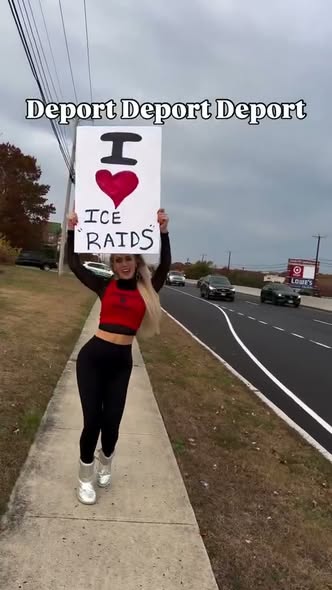
In today’s political climate, it doesn’t take much to light a match. One image, one sign, one moment frozen on a phone camera—and suddenly social media is on fire. That’s exactly what’s happening here. A woman standing on a sidewalk holding a sign that openly supports ICE raids, smiling confidently as cars pass by. To some, it’s empowering. To others, it’s infuriating. And to the internet? It’s irresistible.
What’s fascinating isn’t just the sign itself—it’s the reaction. The outrage. The disbelief. The spiral of commentary, screenshots, reposts, and hot takes. This image isn’t just a political statement; it’s a case study in how modern politics functions in the age of virality.
The Power of a Simple Message
The sign is blunt. No policy paper. No nuance. Just a few words designed to provoke. That’s the point. In a world saturated with long explanations and endless debates, simplicity cuts through the noise. Whether you agree with the message or not, you notice it.
Supporters see it as unapologetic honesty—a refusal to tiptoe around immigration enforcement or soften language to avoid backlash. Critics see it as inflammatory, cruel, or deliberately antagonistic. Both sides react strongly, which is precisely why the image spreads.
Outrage is currency online, and this sign cashes in immediately.
Free Speech Cuts Both Ways
One of the most ironic elements of the backlash is that many of the loudest critics are also vocal defenders of free expression—until it’s expression they hate. The same people who champion protest culture, disruptive demonstrations, and controversial speech suddenly argue that this crosses a line.
But free speech isn’t designed to protect comfort. It protects disagreement.
Standing on a public sidewalk with a sign—even one that angers people—is lawful, protected, and deeply American. You don’t have to like the message to acknowledge the right to say it. The moment speech is only acceptable when it aligns with one ideology, it stops being free.
That contradiction is a big reason emotions run so high.
Immigration: The Third Rail of Politics
Few issues trigger stronger reactions than immigration. It blends law, economics, identity, compassion, and national sovereignty into one explosive topic. People aren’t just arguing policy—they’re defending values, worldviews, and visions of what the country should be.
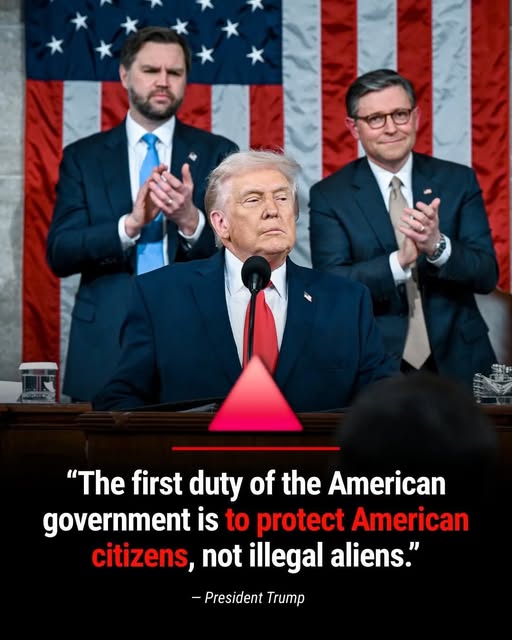
To supporters of strict enforcement, ICE raids represent law and order, fairness to legal immigrants, and the integrity of borders. To opponents, they symbolize fear, family separation, and systemic injustice. These are deeply emotional frames, and neither side believes the other is simply “misinformed”—they believe the other is morally wrong.
That’s why a single sign can feel like a personal attack.
Why the Reaction Feels So Unhinged
What really makes moments like this stand out is how disproportionate the response can become. One individual with a sign suddenly becomes a national villain or hero, depending on your timeline. Comment sections fill with rage, insults, and moral absolutism. People who have never met her speak with total certainty about her character, intelligence, and intentions.
That’s not accidental. Social media rewards extremes. Calm disagreement doesn’t go viral. Anger does. Algorithms don’t care about truth or balance—they care about engagement. And nothing engages like feeling offended.
So when people say, “This is making the Left lose their minds,” what they’re really observing is how outrage has become performative. It’s not just disagreement—it’s theater.
Provocation as a Strategy
It would be naïve to pretend provocation isn’t part of the equation. Holding a sign like this in public today is a conscious choice to poke the hornet’s nest. And there’s nothing illegal—or even unusual—about that. Political activism has always involved provocation. The difference now is speed and scale.
What once might have annoyed a few passersby now reaches millions within hours. The reaction multiplies. The symbolism grows. And the original message becomes secondary to the meltdown it triggers.
In many cases, the outrage becomes the story.
The Bigger Picture
This moment isn’t really about one woman or one sign. It’s about a country deeply divided, where symbols matter more than substance and reactions matter more than resolution. It’s about how people increasingly talk past each other rather than to each other.
And it’s also a reminder that discomfort is not the same as harm. Being offended does not mean your rights were violated. Democracy is noisy, messy, and often unpleasant—but it only survives when people tolerate speech they despise.
Final Thought
You don’t have to agree with the message. You don’t even have to respect it. But the sheer intensity of the backlash says more about our political culture than about the sign itself. When one expression can send thousands into rage spirals, it’s worth asking whether the problem is the speech—or our inability to coexist with disagreement.
If nothing else, this image proves one thing beyond doubt:
free speech is alive, outrage is profitable, and America is still arguing loudly about who it is and where it’s going.