In moments of national tension, facts are often the first casualty. Headlines race ahead of evidence, narratives harden before investigations conclude, and public opinion is shaped not by what happened—but by what is most emotionally convenient to believe. This pattern has repeated itself yet again, and the consequences of ignoring reality are growing more dangerous by the day.
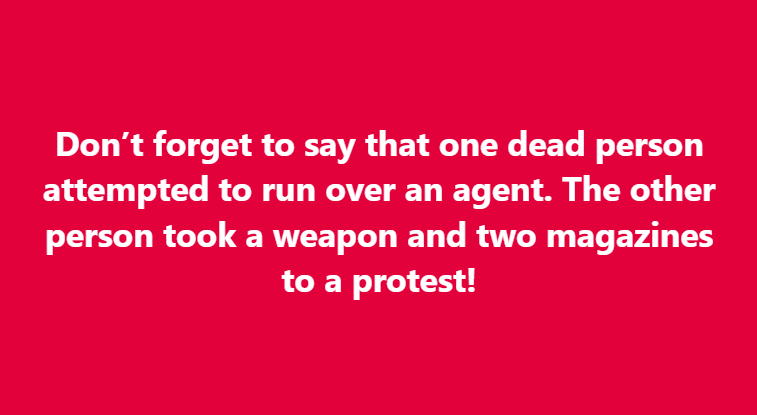
What cannot be ignored—no matter how uncomfortable—is this: one individual involved in the incident attempted to run over a law enforcement agent. Another arrived at a protest carrying a firearm and two loaded magazines. These are not minor details. They are not footnotes. They are central facts that fundamentally change the moral and legal context of what occurred.
Yet too often, these facts are quietly omitted or minimized in public discussion. Instead, simplified narratives take their place—ones that cast violence as victimhood and law enforcement as the sole aggressor. This selective framing does not inform the public. It misleads it.
Attempting to run over an agent with a vehicle is not protest. It is a potentially lethal act. A vehicle, used in this way, becomes a weapon. Law enforcement officers are trained to recognize this threat because history has shown—again and again—that vehicles have been used to kill and maim officers and civilians alike. Pretending otherwise does not make it less true.
Similarly, arriving at a protest armed with a weapon and additional magazines is not an expression of peaceful dissent. Regardless of political alignment, this action escalates risk for everyone present: protesters, bystanders, and officers. Firearms at volatile gatherings turn moments of tension into moments of irreversible tragedy in seconds. Acknowledging that reality is not political—it is responsible.
The refusal to confront these facts reflects a deeper problem: a growing unwillingness to assign personal responsibility. Instead of asking why individuals chose to escalate situations into deadly confrontations, blame is reflexively shifted to institutions, systems, or officers who were forced to respond to immediate threats. This inversion of accountability does not lead to justice. It leads to confusion, distrust, and repeated cycles of violence.
Law enforcement does not appear in a vacuum. Officers are called into situations already spiraling out of control. They do not decide who shows up armed. They do not decide who uses vehicles as weapons. They respond to choices already made by others—often in seconds, under extreme stress, with incomplete information, and with lives on the line.
None of this means law enforcement should be beyond scrutiny. Accountability matters. Training matters. Standards matter. But accountability must be rooted in facts, not ideology. When we erase the actions that led to force being used, we distort the truth and undermine legitimate oversight.
There is also a profound human cost to this distortion. Officers are people. They have families. They leave home each day knowing that routine interactions can turn fatal without warning. When an individual attempts to run them down with a car or brings a firearm into an already unstable environment, the risk is not theoretical—it is immediate and personal. Ignoring that reality dehumanizes those tasked with public safety.
At the same time, communities suffer when truth is replaced by selective outrage. When young people are taught that violent actions are excusable if framed correctly, we set them up for failure—and sometimes death. We send the message that consequences are optional, that escalation is justified, and that accountability belongs only to others. That is not compassion. It is abandonment.
The media plays a powerful role in shaping these perceptions. When critical facts are buried, delayed, or excluded entirely, the public is denied the full picture needed to make informed judgments. Responsible journalism demands context, even when that context complicates a preferred narrative. Especially then.
It is possible to mourn loss while still acknowledging responsibility. It is possible to demand accountability while still recognizing lawful self-defense. These ideas are not mutually exclusive—but they require honesty. And honesty requires us to say, clearly and without apology, that attempting to run over an agent is a life-threatening act, and that bringing a weapon and multiple magazines to a protest is an escalation that endangers everyone.
If we want fewer tragedies, we must start telling the truth before the next one happens. That means resisting emotional shortcuts. It means rejecting narratives that erase agency. And it means reaffirming a simple principle that should unite us all: choices have consequences, and facts do not change based on who we sympathize with.
Ignoring that truth does not make society safer. It makes the next tragedy more likely.