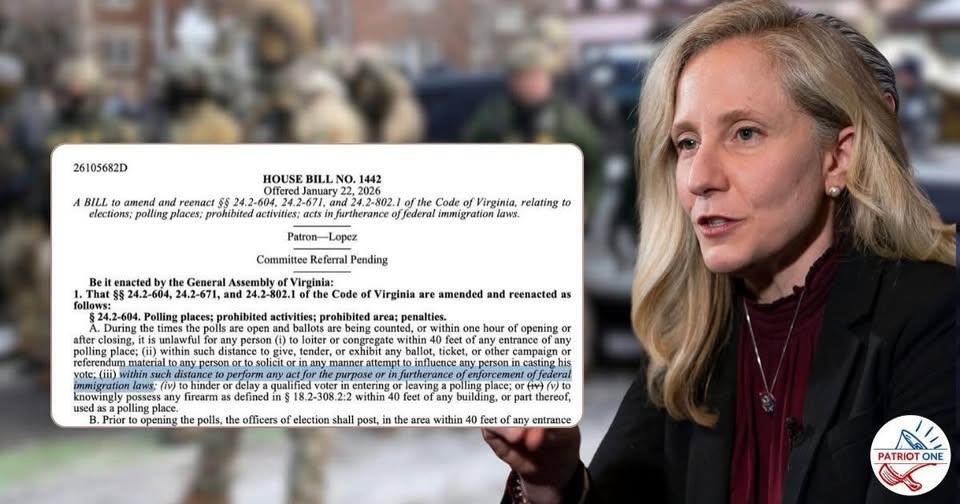
Virginia has enacted a new law restricting certain law-enforcement activities, including immigration enforcement, within a defined distance of polling places on Election Day. The legislation, passed by the Virginia General Assembly and signed into law this week, has sparked sharp political debate and intense reactions online, particularly around claims that it “protects illegal aliens” during elections.
Supporters of the law say its purpose is straightforward: to protect voters from intimidation and ensure free, fair, and accessible elections. Under the statute, most law-enforcement actions unrelated to election security are prohibited within a specified perimeter of polling locations during voting hours. Lawmakers backing the bill argue that visible enforcement activity—regardless of the agency involved—can deter lawful voters from participating, especially in communities with a history of distrust toward authorities.
Critics, however, have seized on the law’s application to immigration enforcement, questioning why federal agents such as ICE would be restricted near polling places at all. Some argue that non-citizens have no legal reason to be present at voting locations and claim the law unnecessarily shields individuals who are not eligible to vote. These critics frame the legislation as politically motivated and accuse state leaders of prioritizing undocumented immigrants over election integrity.
Election officials and legal experts counter that the law does not grant voting rights to non-citizens, nor does it prevent immigration enforcement outside the limited buffer zone. They emphasize that existing federal and state laws already make it illegal for non-citizens to vote, and that the new statute does nothing to change voter eligibility or registration requirements. Instead, they say, the measure mirrors long-standing “polling place buffer” laws used across the country to prevent voter intimidation by anyone—including political groups, private citizens, or government agents.
The controversy highlights a broader national tension between immigration enforcement and voting rights, as well as the role of perception in election security. While there is no evidence that undocumented immigrants are voting in Virginia elections, the debate underscores how emotionally charged the intersection of immigration and elections has become, particularly in the wake of heightened political polarization.
As the law takes effect, Virginia officials say enforcement will focus on education and compliance rather than punishment. Whether the measure reduces voter anxiety or continues to fuel partisan conflict remains to be seen, but it has already become a flashpoint in the wider national conversation over trust in elections and government authority.