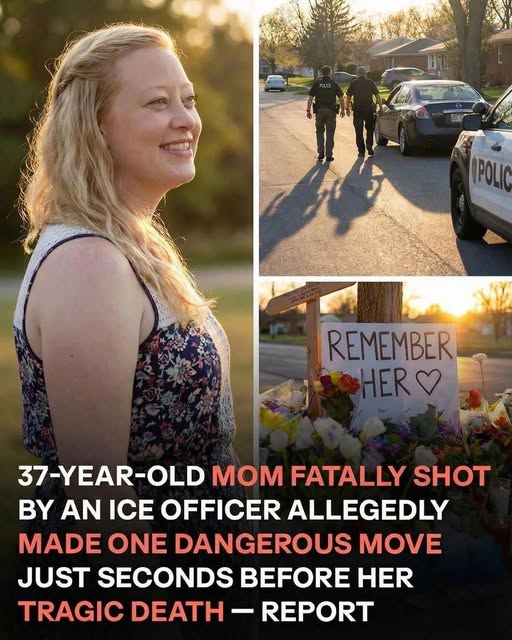
The death of Renee Nicole Good has been described in headlines as the result of “one dangerous move” made “just seconds before” she was fatally shot. That framing alone should give us pause.
Because when a life ends, especially at the hands of law enforcement, the story often becomes compressed into a narrow window of time—seconds, gestures, movements—while the full humanity of the person lost is pushed to the margins.
According to early reports, the incident unfolded quickly. As with many such cases, official accounts focus on a moment of perceived threat, a decision made under pressure, and a rapid escalation that ended in irreversible loss. These reports suggest that an action interpreted as dangerous occurred shortly before the shooting. That is the language being used: interpreted, perceived, reported.
And those words matter.
The Problem With “What Led To It”
Asking “what led to it” can sound reasonable. But too often, that question quietly shifts focus away from the most important fact: a 37-year-old mother is dead.
When reporting centers on a single alleged movement or decision, it risks implying inevitability—suggesting that death was the natural consequence of a moment, rather than the result of a chain of choices, systems, protocols, and power dynamics.
Seconds do not exist in isolation.
Neither do people.
The Weight of the Word “Allegedly”
Much of what is being shared publicly is still alleged. Investigations are ongoing. Evidence must be reviewed. Independent verification matters. History has taught us—again and again—that early narratives are often incomplete, sometimes inaccurate, and frequently shaped to justify outcomes rather than examine them.
That does not mean dismissing officer safety concerns. It does mean resisting the urge to accept simplified explanations before the full picture is known.
Because once a narrative hardens, it becomes difficult to undo—especially for the family left behind.
A Mother, Not a Moment
Renee Nicole Good is being remembered not for who she was, but for how she died. That is one of the quiet tragedies layered on top of the obvious one.
She was a mother.
She was a person with routines, relationships, fears, hopes.
She was not a headline.
She was not a “move.”
When the focus remains on her final seconds, it obscures the reality that no action should automatically carry a death sentence, particularly in encounters where power is uneven and consequences are final.
Why These Stories Hurt So Deeply
Cases like this strike a nerve because they sit at the intersection of fear, authority, and irreversibility. They raise questions people are afraid to ask out loud:
- How much interpretation is too much?
- When does perceived threat override human life?
- Who gets the benefit of doubt—and who doesn’t?
- Why do so many of these encounters end in death rather than de-escalation?
These are not abstract questions for families who lose someone. They are permanent.
Language Shapes Judgment
Phrases like “dangerous move” carry weight. They frame public perception before evidence is fully examined. They subtly suggest blame. They prepare audiences to accept loss as justified rather than tragic.
But danger is not an objective fact—it is often a judgment made in fractions of a second, under stress, informed by training, assumptions, and fear.
That does not make every judgment wrong.
It does make every judgment worthy of scrutiny.
The Family Lives With the Aftermath
While the public debates, Renee’s family lives with absence. With unanswered questions. With the unbearable reality that someone who woke up that morning did not come home.
For them, this is not about policy or protocol. It is about a chair that stays empty. A voice that no longer answers the phone. A future that will never unfold as imagined.
No report can restore that.
What Responsibility Looks Like Right Now
Responsibility, in moments like this, looks like:
- Letting investigations unfold fully
- Demanding transparency without rushing to conclusions
- Refusing to reduce a life to a single moment
- Centering compassion over commentary
It also means acknowledging that even if procedures were followed, the outcome can still be devastating, unacceptable, and worthy of grief.
Remembering Her Correctly
Renee Nicole Good should be remembered first as a human being—not as an incident, not as a cautionary tale, not as a justification.
Her life mattered before the final seconds.
It mattered independently of any report.
It matters now.
continue.