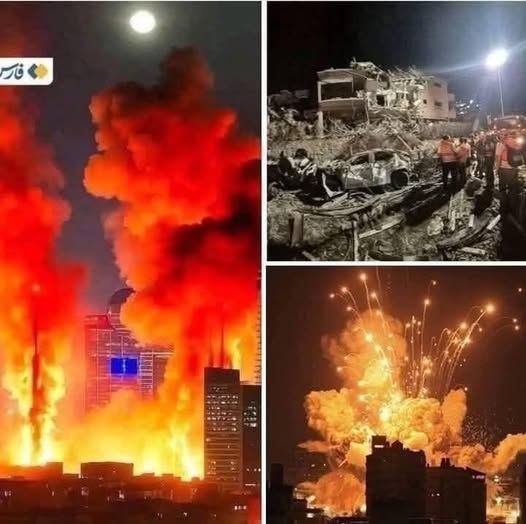
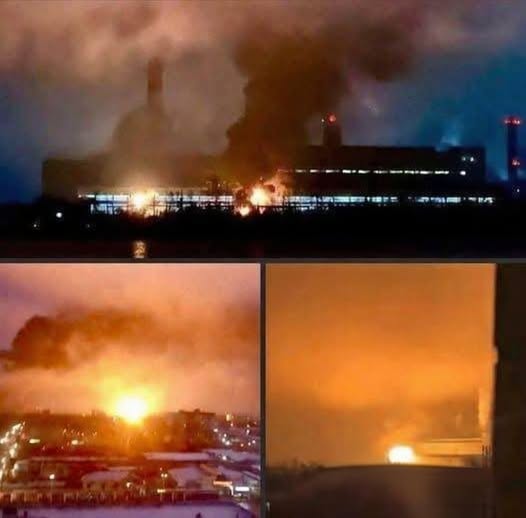
In moments of global tension, images like these spread fast. Flames lighting the night sky. Buildings reduced to rubble. Explosions frozen in dramatic frames. Paired with phrases like “BREAKING NEWS,” “maximum worldwide alert,” or “the war begins,” they are designed to provoke an immediate emotional response. Fear. Shock. Urgency. And once that reaction sets in, reason often takes a back seat.
But images alone—even disturbing ones—do not tell the full story. In fact, without context, they often tell the wrong one.
The idea that a single post or collage could signal the beginning of a global war misunderstands how international crises unfold and how real-world alerts are issued. Wars do not begin with viral graphics. Global emergencies are not announced through anonymous captions. And worldwide alerts are not triggered by images circulating without dates, locations, or credible sources.
What we are seeing here is not confirmation of a global event—it is a familiar pattern of fear amplification.
Historically, dramatic images from conflict zones have been reused, recycled, and repurposed countless times. Footage from one war is often reposted years later during another crisis, stripped of its original context and presented as “new.” Sometimes images from entirely different countries or decades are grouped together to create the illusion of escalation. Other times, scenes from military exercises, industrial accidents, or even movie sets are passed off as active combat.
This works because most viewers do not have the time—or emotional distance—to stop and verify what they are seeing. When something looks catastrophic, the instinct is to believe it. But belief is not the same as truth.
The language used in posts like this is also a warning sign. Phrases such as “maximum worldwide alert” sound official, but they are deliberately vague. No government agency uses language like that without specifying who issued the alert, when it was issued, and what it applies to. Real emergency notifications are precise, formal, and verifiable. They come through established channels: government statements, official alerts, and reputable news organizations—not social media graphics.
Another important detail is the absence of specifics. Where did this happen? When did it happen? Who is involved? These are the first questions any legitimate breaking-news report answers. When those details are missing, it is usually because the person sharing the content either does not know them—or does not want you to ask.
Panic thrives in ambiguity. The less you know, the more your imagination fills in the gaps.
If a global conflict were truly beginning, the signs would be unmistakable. Multiple governments would issue coordinated statements. International news agencies would interrupt regular programming. Financial markets would react instantly. Airlines, embassies, and emergency systems would issue public guidance. None of that happens quietly or informally.
Instead, what often happens online is emotional escalation without factual escalation. One alarming post leads to another. People add captions, interpretations, and assumptions. Each share strips away more nuance until the original context—if there ever was one—is completely lost.
This does not mean the world is peaceful or free from violence. Tragically, conflict exists in many places at all times. People are suffering right now in regions that rarely make headlines. But acknowledging that reality is different from declaring the start of a global war based on unverified imagery.
There is also a deeper danger in spreading posts like this without verification. Fear spreads faster than facts, and panic can cause real harm. It heightens anxiety, triggers stress responses, and can lead people to make irrational decisions. During genuine emergencies, misinformation overwhelms communication channels, making it harder for accurate information to reach those who need it most.
In recent years, the rise of artificial intelligence and digital manipulation has made this problem worse. Images can now be altered convincingly or generated entirely from scratch. Even experienced viewers can be misled. This makes skepticism not a sign of denial, but of responsibility.
Responsible engagement does not mean ignoring troubling images. It means slowing down. It means asking basic questions. It means resisting the urge to share something simply because it feels urgent.
Before believing or reposting claims like these, it helps to pause and consider: Is there a credible source attached? Has this been confirmed by multiple independent outlets? Are there official statements? Are the images traceable to a specific time and place? If the answer is no, then the most honest response is uncertainty—not alarm.
There is also a moral dimension to this. When old or unrelated images are used to claim a new catastrophe, they exploit real suffering for attention. They turn genuine tragedies into tools for engagement, fear, or influence. That does not honor the people who lived through those events—it distorts them.
The modern information environment rewards speed, not accuracy. Posts that trigger fear travel farther and faster than those that promote clarity. But each person who chooses not to amplify unverified claims weakens that cycle.
It is worth remembering that real global emergencies do not rely on virality. They are impossible to hide and impossible to miss. When something truly world-altering happens, you do not need to be told to panic—you will be informed clearly, repeatedly, and through official channels.
Until that happens, caution is not complacency. It is wisdom.
The world does not need more fear. It needs discernment. It needs people willing to say, “I don’t know yet,” instead of “this is the end.” It needs calm voices that insist on evidence before emotion.
Dramatic images will continue to circulate. Urgent captions will continue to appear. But the difference between being informed and being manipulated lies in how we respond.
Slowing down is not weakness.
Questioning is not denial.
And refusing to spread panic is an act of responsibility.
Until verified facts replace speculation, the most accurate statement we can make is simple: this image alone does not confirm what it claims.