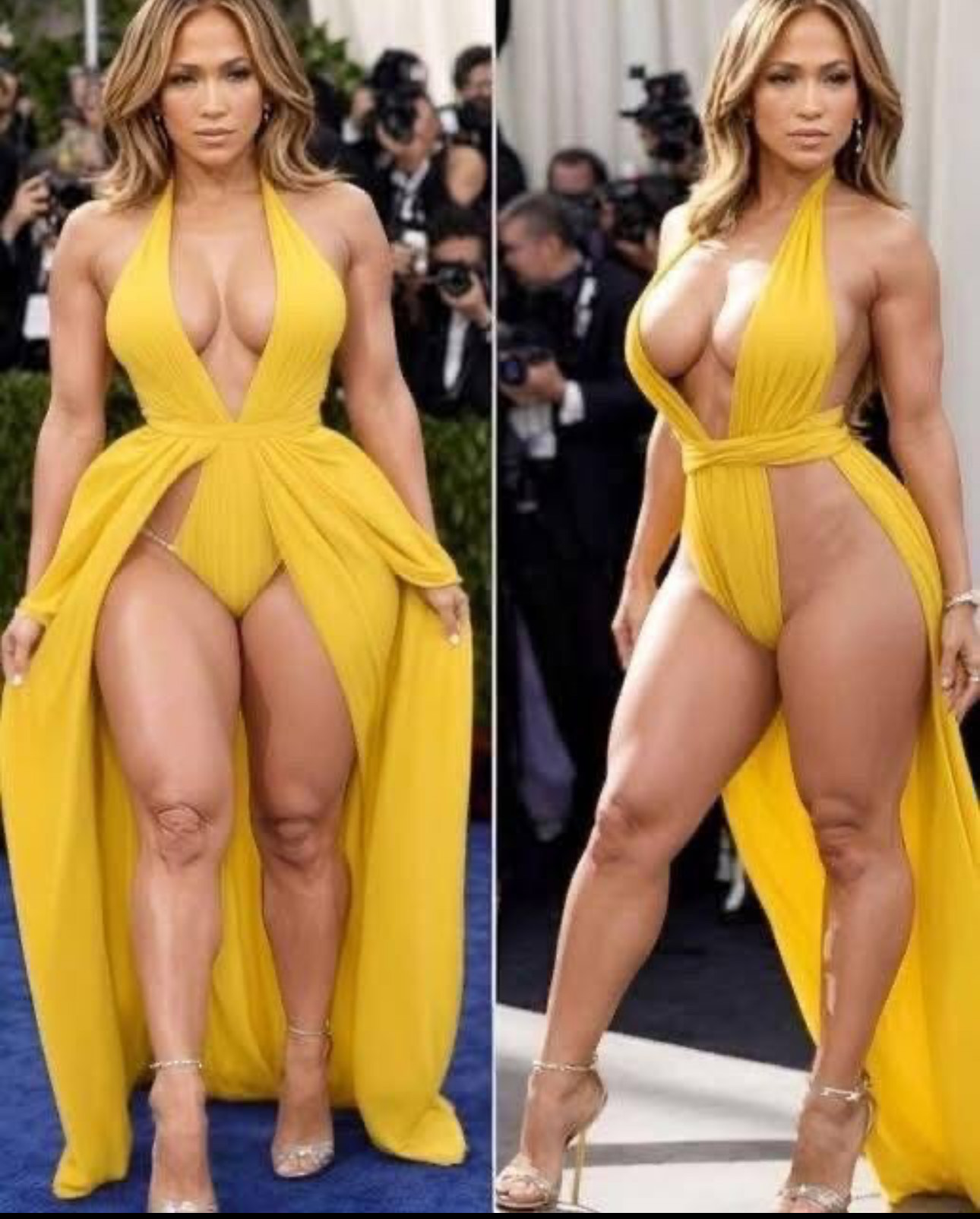
Social media has a way of turning a single image into a full-blown story overnight. A dramatic caption, a familiar face, and just enough mystery to spark curiosity—and suddenly, millions of people are being told they’re about to uncover a shocking revelation. That’s exactly what’s happening with the viral post claiming that Jennifer Lopez is “showing off her new boyfriend” and that viewers should “sit down” because they might recognize him.
The problem?
There is no new boyfriend being revealed in this image.
And there is no hidden man waiting in the comments.
What we’re really seeing is a classic example of modern clickbait culture—one that thrives on implication rather than fact.
At first glance, the post feels convincing. It shows two striking photos of Jennifer Lopez on a red carpet, wearing a bold yellow gown that immediately commands attention. The lighting is dramatic. The photographers are visible. Everything about the image screams celebrity moment. The caption then plants the seed: a “new boyfriend” you’ll recognize. Instantly, curiosity kicks in.
But if you stop scrolling for just a moment and actually examine what’s being shown, the illusion starts to fall apart.
There is no man in the photo.
No interaction.
No reveal.
No confirmation.
Just Jennifer Lopez—alone, photographed from slightly different angles, at a high-profile event.
The key to this post’s effectiveness is suggestion without substance. It never says who the supposed boyfriend is. It never links to an interview. It never cites a source. Instead, it pushes readers to the comments, where engagement—not truth—is the goal. Once there, users are met with speculation, spam links, or unrelated pages designed to generate traffic or followers.
This tactic works because Jennifer Lopez’s personal life has always been of public interest. Her relationships, marriages, breakups, and reconciliations have been followed for decades. That history makes it easy for false narratives to latch on. People expect news about her love life—so they don’t question it as closely.
But here’s the reality:
There has been no verified announcement, no public appearance, and no credible reporting confirming that Jennifer Lopez is debuting a new boyfriend in this image. None.
The photos themselves are from a public red-carpet appearance—an event where celebrities are photographed individually, often dozens of times, in different poses and angles. The side-by-side images are not a “before and after,” not a reveal, and not evidence of anything beyond wardrobe styling and camera perspective.
Another reason these posts spread so quickly is the visual emphasis on appearance rather than context. The outfit becomes the story. The confidence becomes the hook. And suddenly, viewers are encouraged to look for meaning where none exists. This turns a fashion moment into a fabricated relationship narrative.
It’s also worth noting how language is used to manipulate emotion. Phrases like “you better sit down” and “you might recognize him” are psychological triggers. They create anticipation and urgency, even though nothing is actually being offered. It’s the promise of a payoff that never comes.
This kind of post doesn’t aim to inform—it aims to engage. Likes, comments, shares, follows. Truth is optional.
What makes this especially important to talk about is how normalized this behavior has become. Many users now assume that if something is widely shared, it must be real. But virality is not verification. In fact, the more outrageous or mysterious a claim is, the more likely it is to spread—especially when it involves a global celebrity.
Jennifer Lopez herself has been open in interviews about how frustrating misinformation can be. Being constantly linked to rumors, fake headlines, and invented stories turns a real person into a character people feel entitled to rewrite. And while she has the platform to correct false narratives, many others do not.
This post also highlights a larger issue: how women in the public eye are often reduced to relationship speculation, even when the content has nothing to do with romance. A solo red-carpet appearance becomes a dating rumor. Confidence becomes an invitation for projection. Style becomes scandal.
And the comments—where the post sends you—often amplify the confusion. People guess names. Others argue. Some share unrelated links. Very few stop to ask the most basic question: Where is the evidence?
There isn’t any.
No reputable entertainment outlet has reported a “new boyfriend reveal” tied to this image. No confirmed sightings. No statements. No follow-up photos. Just a loop of recycled speculation feeding itself.
So why does this matter?
Because misinformation doesn’t always look like obvious lies. Sometimes it looks like a glamorous photo and a playful caption. Sometimes it’s designed not to deceive maliciously, but to exploit curiosity. And when that becomes normal, it changes how people consume information—not just about celebrities, but about everything.
The truth is far simpler—and far less dramatic.
Jennifer Lopez attended an event.
She wore a striking dress.
She was photographed.
That’s it.
No secret boyfriend.
No hidden reveal.
No shocking admission waiting in the comments.
The real takeaway from this viral post isn’t about her personal life—it’s about how easily narratives are manufactured online, and how important it is to slow down before believing them.
Next time you see a headline promising a revelation but refusing to deliver details upfront, pause. Ask for sources. Ask for confirmation. And remember: if the truth were really that shocking, it wouldn’t be hiding in a comment section.
Sometimes, a photo is just a photo—and the story around it says more about the internet than it does about the person in the frame.