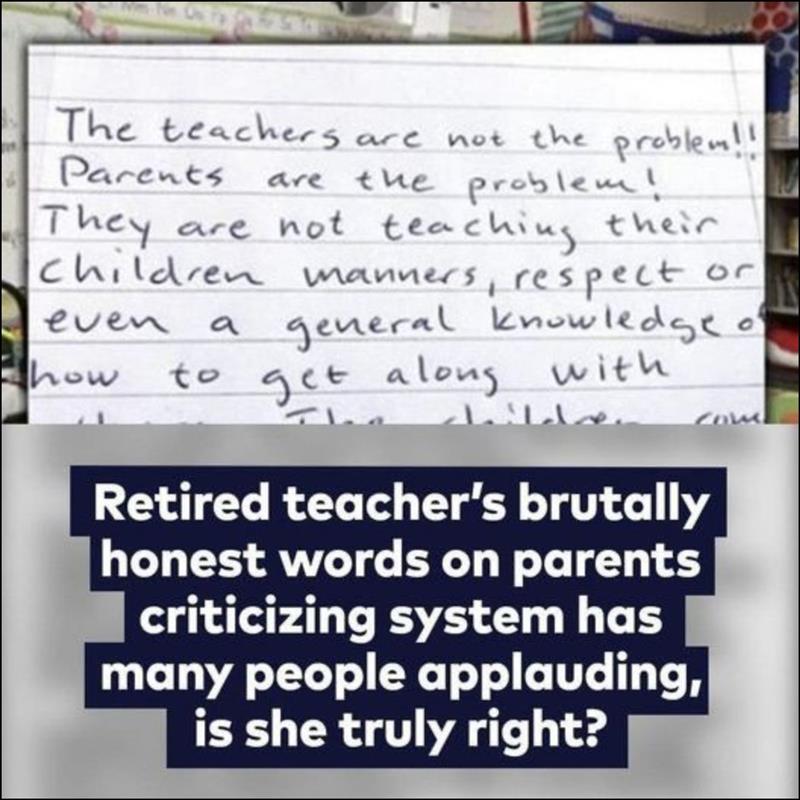
The image is simple, but the words hit hard.
Written in plain handwriting on lined paper, the message begins with a declaration that has ignited debate across the internet:
“The teachers are not the problem. Parents are the problem.”
Below it, the message continues, accusing parents of failing to teach children manners, respect, and basic social skills. Accompanied by a bold caption asking whether the retired teacher is “truly right,” the post has drawn applause, anger, and deep reflection in equal measure.
This isn’t just a viral quote. It’s a lightning rod for a conversation many have been avoiding.
Why This Message Resonates So Strongly
The reason this note exploded online is simple: it voices a frustration that many educators feel but rarely say out loud. Coming from a retired teacher — someone no longer bound by institutional pressures — the message carries an air of honesty that feels unfiltered and raw.
For some readers, it’s a breath of fresh air.
For others, it feels like an unfair attack.
But almost no one scrolls past it without reacting.
The Core Claim: Where Responsibility Begins
At the heart of the message is a clear argument: schools cannot compensate for what children aren’t taught at home. According to the note, teachers are expected to educate academically and manage behavior that should have been addressed long before a child entered a classroom.
The retired teacher points to:
- Lack of manners
- Disrespect toward authority
- Poor social skills
- Inability to cooperate with peers
Her implication is blunt: teachers are being blamed for systemic problems that begin outside the classroom.
Why Many Teachers Are Applauding
Educators in the comments largely express agreement. Many describe classrooms where instructional time is consumed by behavioral management rather than learning. They talk about being expected to parent, discipline, counsel, and educate simultaneously — often with limited support.
Some note that when teachers attempt to enforce boundaries, they’re met not with support, but with backlash from parents who defend every action of their child.
For them, the retired teacher’s words feel validating.
Why Parents Are Pushing Back
Parents who disagree argue that the message oversimplifies a complex issue. They point out that many families are overwhelmed — juggling work, finances, mental health challenges, and societal pressures that didn’t exist decades ago.
Others say schools have changed too, with larger class sizes, fewer resources, and shifting expectations placed on children themselves.
To them, the note feels accusatory rather than constructive.
A Generational Divide
Part of the tension comes from generational differences. Many retired teachers taught in an era when:
- Authority was rarely questioned
- Discipline was more rigid
- Parents deferred to schools
Today’s education system operates differently. Collaboration, accommodation, and individualized approaches are emphasized — sometimes at the cost of clear boundaries.
The retired teacher’s message reflects older expectations colliding with modern realities.
Is It Really One Side’s Fault?
What makes this debate so heated is that both sides feel blamed — and both sides are partially right.
Children don’t learn respect in a vacuum.
Teachers can’t teach effectively in chaos.
Parents can’t singlehandedly counter every social influence.
The viral note simplifies a deeply layered problem — but simplicity is often what makes messages spread.
Why Honesty Feels “Brutal” Now
Years ago, this message might have stayed within teachers’ lounges. Today, shared publicly, it feels shocking — not because it’s new, but because it’s rarely spoken so plainly.
The phrase “brutally honest” keeps appearing in reactions. That says more about cultural discomfort than about the words themselves.
We’re not used to uncomfortable truths being stated without cushioning.
The Emotional Undercurrent
Beyond policy debates, this post touches something emotional. Many adults see reflections of their own childhoods, their parenting struggles, or their teaching burnout.
Some feel guilt.
Some feel anger.
Some feel relief that someone finally said it.
That emotional mix is why the post continues circulating.
What the Message Doesn’t Say — But Implies
The note doesn’t call parents bad people. It doesn’t say teachers are perfect. What it implies is something more uncomfortable: that education is a shared responsibility, and that balance has been lost.
When responsibility shifts too far in one direction, resentment builds. This note is the sound of that resentment finally being voiced.
A Conversation Worth Having — Even If It Hurts
Whether you agree or disagree, the retired teacher’s message has succeeded in one important way: it has forced a conversation.
Education doesn’t improve through silence. It improves through honest, sometimes painful dialogue about expectations, roles, and accountability.
Avoiding that conversation hasn’t worked. That’s why a handwritten note has struck such a nerve.
Final Thoughts
Is the retired teacher “truly right”?
Not entirely. But she’s not entirely wrong either.
Her words don’t offer solutions — they offer a mirror. And not everyone likes what they see reflected.
What this viral message proves is that education is no longer just about schools or parents. It’s about rebuilding a partnership that’s been strained by blame, exhaustion, and changing norms.
The applause, the outrage, and the debate all point to the same truth:
Something in the system isn’t working — and ignoring it won’t fix it.
Sometimes, uncomfortable honesty is the first step toward real change.