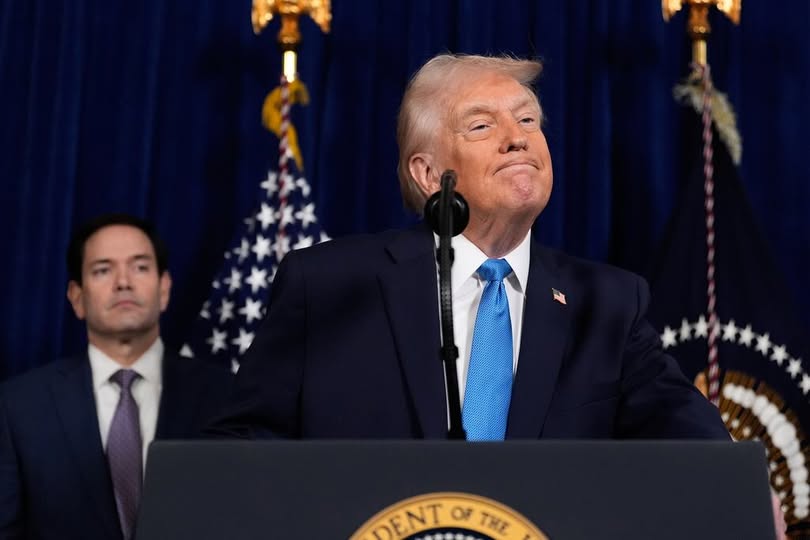
A widely shared image showing Donald Trump at a presidential podium has reignited debate over a controversial idea long discussed in political circles: the possibility of seizing and revitalizing Venezuela’s vast oil industry. Framed as a bold strategy to weaken an adversarial regime while reshaping global energy markets, the proposal has drawn both strong support and intense criticism — and faces enormous practical, legal, and geopolitical obstacles.
While the idea may sound decisive, experts agree that transforming it into reality would be extraordinarily difficult.
The Strategic Appeal of Venezuela’s Oil
Venezuela possesses some of the largest proven oil reserves in the world. For decades, its energy sector was a cornerstone of the national economy and a key supplier to international markets. Supporters of aggressive U.S. action argue that restoring production could stabilize global oil prices, weaken hostile governments, and benefit American energy interests.
From this perspective, Trump’s rhetoric about taking control of Venezuela’s oil industry fits into a broader worldview emphasizing economic leverage, resource security, and confrontational diplomacy.
But what sounds straightforward in theory becomes far more complex in practice.
Sovereignty and International Law
The most immediate hurdle is international law. Venezuela is a sovereign nation, and forcibly seizing its oil infrastructure would constitute an act of war under international norms. Even with allegations of corruption, authoritarianism, or criminal activity within the Venezuelan government, unilateral seizure would violate foundational principles of state sovereignty.
Legal scholars note that such an action would likely provoke condemnation from the United Nations, key U.S. allies, and global institutions. It could also trigger retaliatory measures, sanctions disputes, and legal challenges in international courts.
The Reality on the Ground
Venezuela’s oil infrastructure is not simply waiting to be “revitalized.” Years of mismanagement, sanctions, lack of investment, and skilled labor shortages have severely degraded production capacity. Refineries are aging, pipelines are deteriorated, and technical expertise has fled the country.
Even if control were somehow achieved, restoring production would require massive capital investment, years of work, and cooperation from local labor forces — cooperation that cannot be assumed under foreign control.
Military and Security Risks
Any attempt to seize oil assets would require securing facilities across a large and politically unstable country. That would likely involve prolonged military presence, significant troop deployment, and ongoing security operations to protect infrastructure from sabotage or insurgency.
Defense analysts warn that such a scenario could quickly evolve into a long-term entanglement, draining resources and exposing U.S. forces to asymmetric threats.
Regional and Global Fallout
Latin American nations have historically opposed U.S. military intervention in the region, regardless of political alignment. A move against Venezuela’s oil sector could strain diplomatic relations across the hemisphere and push regional governments closer to rival powers.
Global competitors would also respond. Venezuela has existing relationships with Russia, China, and Iran — all of which have strategic and economic interests in the country. Any U.S. seizure effort could escalate into a broader geopolitical confrontation.
Domestic Political Constraints
Within the United States, such a plan would face intense scrutiny. Congress would likely demand authorization, oversight, and clear justification. Public opinion remains deeply divided on foreign military interventions, particularly those involving resource control.
Past experiences in the Middle East have left many Americans wary of nation-building efforts framed around oil or economic gain.
Economic Questions and Market Reality
Ironically, even a successful revitalization might not deliver the economic benefits proponents imagine. Global oil markets are complex, influenced by OPEC decisions, renewable energy growth, and fluctuating demand. Injecting Venezuelan oil back into the market could lower prices — benefiting consumers but hurting domestic producers.
Additionally, operating a foreign oil industry under military or transitional control would be extraordinarily expensive, with uncertain returns.
The Venezuela Factor
At the center of all this is Venezuela itself. Any long-term solution to the country’s crisis ultimately depends on internal political change, institutional reform, and economic rebuilding. External seizure of assets risks undermining those goals by fueling nationalism, resistance, and instability.
Even critics of the current Venezuelan leadership argue that lasting recovery cannot be imposed from the outside.
Rhetoric vs. Reality
Trump’s statements about Venezuela’s oil resonate because they project strength and decisiveness. They appeal to voters frustrated with prolonged international crises and eager for clear outcomes. But history shows that bold rhetoric often collides with complex realities once policies move beyond speeches.
The gap between declaring intent and executing strategy is vast — and Venezuela’s oil industry sits at the intersection of law, diplomacy, economics, and human cost.
Final Thoughts
The idea of seizing and revitalizing Venezuela’s oil industry may sound like a powerful geopolitical move, but it is riddled with obstacles that go far beyond energy policy. Legal barriers, military risks, regional backlash, and economic uncertainty all stand in the way.
Whether viewed as leverage, strategy, or political messaging, the proposal highlights a familiar truth of global politics: control over resources is never just about oil — it’s about power, people, and consequences.
As debate continues, one thing is clear: any path forward in Venezuela will be far more complicated than a headline or image can capture.